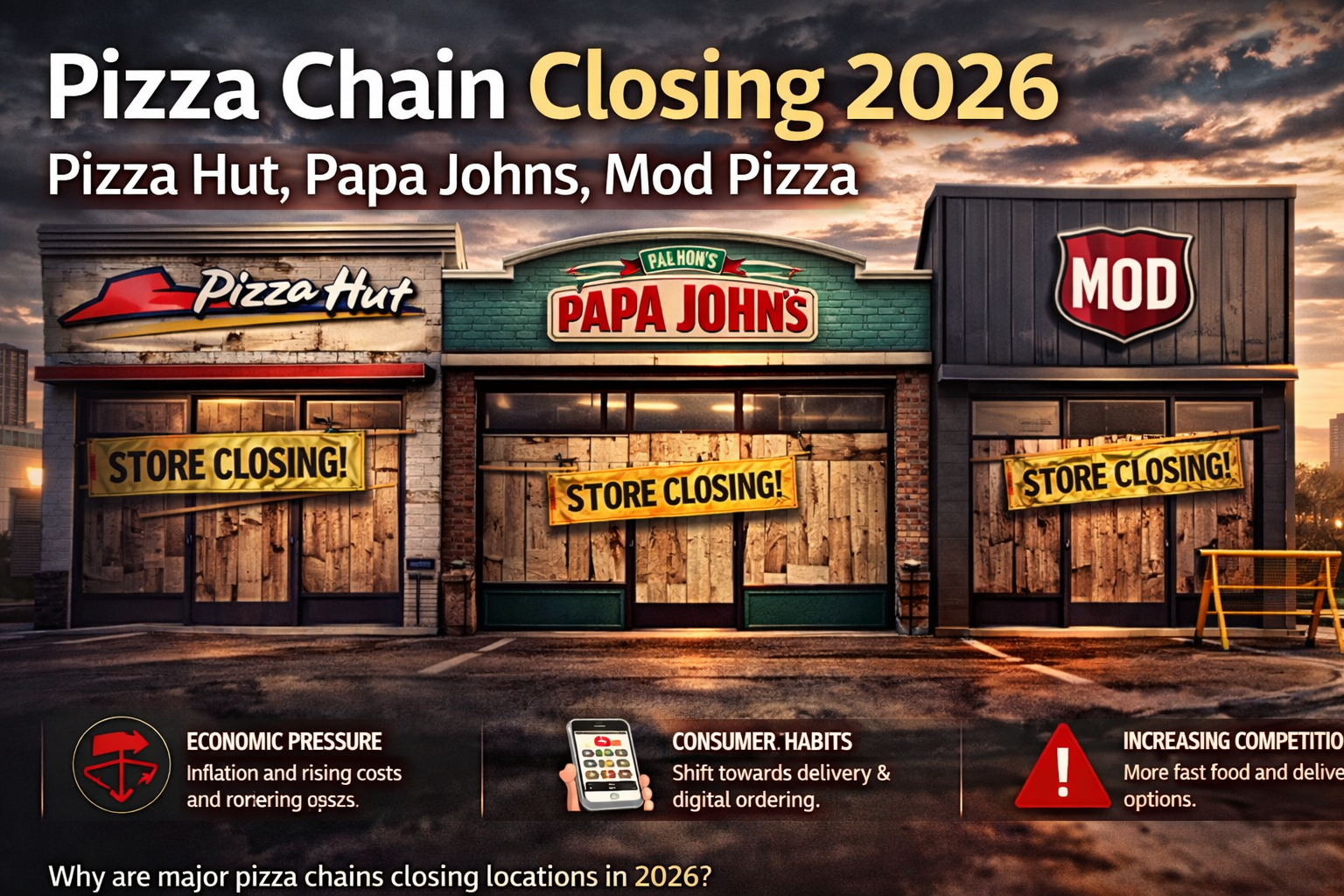
Pizza Chain Closing 2026 — Complete Guide: Pizza Hut Shutters 250 Locations, Papa Johns Closes 300, and the Forces Reshaping America's $50 Billion Pizza Industry
Something is deeply wrong in America's pizza industry. Walk down any suburban strip mall in 2026 and you're increasingly likely to find a darkened Pizza Hut, a papered-over Papa Johns, or a shuttered Mod Pizza where just a few years ago there was a thriving slice of the American fast-food landscape. The numbers tell a stark story: Pizza Hut has announced it will close 250 US locations in the first half of 2026 alone. Papa Johns has revealed plans to shut approximately 300 underperforming restaurants in North America by 2027, with about 200 of those closures happening this year. Mod Pizza, once the fastest-growing pizza chain in America, has shrunk from 500 locations to fewer than 450. Bertucci's Restaurants filed for Chapter 11 bankruptcy in April 2025. And those are just the most prominent casualties in what analysts are calling the most severe downturn in the pizza restaurant sector in decades.
This is not a story about pizza. It's a story about the collision of five powerful economic forces that are simultaneously battering the American restaurant industry: relentless inflation in food and labor costs, a fundamental shift in consumer behavior away from dining out and toward frozen food and home cooking, the rise of delivery apps that eat into restaurant margins with double-digit commission fees, a glut of outdated locations built for a dine-in culture that has largely ceased to exist, and the dominance of one competitor — Domino's Pizza — that figured out the new rules of the game years before everyone else and is now reaping the rewards while its rivals bleed.
Understanding why pizza chains are closing in 2026 requires going back at least a decade, tracing the diverging paths of the major chains from the smartphone era through the pandemic, through the inflation surge of 2022-2023, to the consumer spending slowdown of 2024-2025 that has pushed multiple major brands to the breaking point. It requires understanding how Domino's built a technology and delivery infrastructure that transformed it into effectively a tech company that happens to make pizza — while Pizza Hut spent those same years operating in large, expensive, dine-in restaurants that consumers were increasingly reluctant to visit. And it requires grasping the economics of the franchise model, which can amplify both success and failure: when a franchisee's unit economics deteriorate below break-even, closures become not just likely but mathematically inevitable.
This comprehensive guide covers every major pizza chain closing in 2025 and 2026, the economic forces driving these closures, the contrasting fortunes of winners and losers in the pizza wars, what the closures mean for consumers and franchise owners, and whether the pizza industry's current turbulence represents a temporary correction or a more permanent structural decline. Whether you're a consumer wondering if your local Pizza Hut will survive, an investor tracking the restaurant sector, or simply someone fascinated by how industrial-scale food businesses rise and fall — this is the most detailed analysis available anywhere.
Pizza Hut Closing 250 Locations — The Hut Forward Plan Explained
The most consequential single announcement in the recent wave of pizza chain closings came on February 4, 2026, during Yum! Brands' fourth-quarter 2025 earnings call. Yum! Brands CFO Ranjith Roy revealed that approximately 250 Pizza Hut locations in the United States would be closed in the first half of 2026 — representing roughly 3% of Pizza Hut's roughly 6,700 US locations. The announcement sent shockwaves through the restaurant industry and media coverage of the decision dominated business news for days.
The Financial Context — A Year of Declining Sales
The closures did not come out of nowhere. Pizza Hut had reported a 1% same-store sales decline globally for both the fourth quarter and the full year of 2025 — a relatively modest-sounding number that masks a more serious structural problem. Same-store sales, which measure revenue at locations open at least a year, are the restaurant industry's most closely watched metric because they strip out the effect of new openings and closures to reveal the underlying health of an existing restaurant network. A decline, even a small one, in same-store sales at a large franchise system creates a cascading effect: franchisees see their revenue fall while their fixed costs — rent, labor, insurance, loan payments — remain largely unchanged. The result is a squeeze on margins that, for locations already operating near break-even, quickly becomes unsustainable.
The situation was made worse by the broader context: Yum! Brands reported Q4 2025 revenue of $2.51 billion, beating analyst expectations of $2.45 billion, but missed on earnings per share ($1.73 adjusted versus the expected $1.77). More tellingly, while Taco Bell's same-store sales were up 7% for Q4 and KFC's same-store sales grew about 1%, Pizza Hut was the clear underperformer in Yum!'s portfolio — a fact that makes the contrast between Hut's struggles and the strength of its sibling brands all the more stark.
The Hut Forward Strategy — What It Actually Means
Yum! Brands is framing the closures as part of a broader turnaround initiative called the "Hut Forward" plan, which the company describes as encompassing four pillars: targeted closures of underperforming units, marketing support to strengthen brand awareness, modernization of technology and restaurant models, and Yum! offering a one-time financial contribution to help franchisees with marketing costs.
The underlying logic of the closure strategy is straightforward: a restaurant system where 3% of locations are dragging down the entire system's metrics — by generating negative cash flow that franchisees must absorb, and by providing poor customer experiences that damage the brand — is better off without those 3%. Closing underperforming stores often leads to higher sales at nearby surviving locations as consumers who previously visited the closed location now drive to the nearest open alternative. This "sales transfer" dynamic is well-documented in restaurant economics and is central to why Pizza Hut, Papa Johns, and other chains are willing to accept the upfront pain of closures in exchange for a healthier remaining system.
The Strategic Review — Could Pizza Hut Be Sold?
Perhaps the most dramatic element of Pizza Hut's situation in 2026 is the parallel strategic review launched by Yum! Brands in November 2025. CEO Christopher Turner told analysts that the review — which includes the possibility of selling the Pizza Hut brand entirely — was "proceeding as planned" and would be completed in 2026. Turner declined to provide further details, citing "the nature of the process." This language is the corporate equivalent of saying "we might sell this business but we're not going to tell you to whom or for how much until it's done."
A potential sale of Pizza Hut would represent one of the largest restaurant industry transactions in years, and would be a dramatic ending for a brand with a storied history. Pizza Hut was founded in 1958 in Wichita, Kansas, by brothers Dan and Frank Carney, who borrowed just $600 from their mother to open the first location. The name was chosen because their sign only had room for eight letters. By 1971, Pizza Hut was the largest pizza chain in the world by sales. PepsiCo acquired it in 1977, then spun off its restaurant division — which became Yum! Brands — in 1997.
Papa Johns Closing 300 Locations — The Other Side of the Pizza Crisis
Pizza Hut is not suffering alone. On February 26, 2026, Papa Johns revealed during its earnings call that it plans to close approximately 300 underperforming restaurants in North America by the end of 2027, with about 200 of those closures occurring in 2026. The company had about 3,500 locations at the end of 2025. Papa Johns also announced it was cutting approximately 7% of its roughly 700-person corporate workforce — a significant organizational restructuring that signals the depth of the chain's financial challenges.
Papa Johns' Financial Performance — A Troubling Picture
Papa Johns reported flat revenue of $2.1 billion for fiscal year 2025, compared to the prior year, with net income collapsing from $84 million in 2024 to just $32 million in 2025 — a 62% drop. Global system-wide restaurant sales were $4.92 billion, a mere 1% increase. US same-store sales declined. The chain opened 279 new restaurants in fiscal 2025 — 96 in North America and 183 internationally — but the problem is not new openings, it's the declining performance of existing restaurants.
CEO Todd Penegor, who took over Papa Johns' turnaround effort, outlined a plan focused on menu improvement (including recalibrating restaurant ovens to ensure better cooking and rolling out a new pan pizza), sharpening the chain's value proposition, and closing the underperforming tail of the restaurant system. The closing stores are "generally those doing less than $600,000 in annual revenue" — a figure that, in the context of restaurant economics, represents locations where the business is not viable at any reasonable lease rate or labor cost.
Why Papa Johns Chose to Cut Instead of Remodel
Papa Johns CEO Penegor explicitly framed the closures as a proven strategic playbook: "We expect to close the majority of these restaurants by the end of 2027, with approximately 200 closures occurring in 2026. We believe these closures will further strengthen the system. This is the same strategy we successfully deployed during my tenure managing our international business." The logic is the same as Pizza Hut's: remove the worst-performing restaurants from the system, transfer their sales to nearby surviving locations, and emerge with a leaner, healthier network that performs better on a per-store basis.
Mod Pizza — From Fastest Growing to Fastest Shrinking
Mod Pizza represents perhaps the most dramatic fall from grace in the recent history of the pizza industry. The Seattle-based "fast-casual" pizza chain — known for its individually customized pizzas at a single price — was, until recently, one of the fastest-growing restaurant concepts in America. It had grown from nothing to approximately 500 locations by 2024, attracting significant investor capital and extensive media coverage for its progressive labor practices (including hiring people with criminal records and offering unusually generous employee benefits).
But the business model that made Mod Pizza a darling of the press proved difficult to sustain in a challenging economic environment. Fast-casual restaurants — which offer a higher quality experience than traditional fast food but at lower prices than full-service restaurants — face a particular squeeze when food and labor costs rise: their customers are price-sensitive enough to notice menu price increases but not affluent enough to absorb them as easily as diners at upscale restaurants. Mod Pizza was forced to close 27 locations and sell its assets to Elite Restaurant Group of Chatsworth, California. The new ownership has continued to struggle, with Mod Pizza's website listing 448 units as of February 2026 — down from 500 just two years earlier — and closures continuing.
Bertucci's Restaurants and Other Bankruptcies — The Smaller Victims
Beyond the large chains, several smaller pizza-focused restaurant companies have filed for bankruptcy protection in 2025 and early 2026, painting a broader picture of an industry in genuine distress.
Bertucci's — The Italian-American Pizza Concept That Couldn't Survive
Bertucci's Restaurants, a chain of Italian-American restaurants known for their brick-oven pizzas, filed for Chapter 11 bankruptcy protection on April 24, 2025. The chain, which had been a fixture in the northeastern United States since 1981, had already shrunk significantly from its peak of more than 90 locations. The bankruptcy filing reflected the same forces battering larger chains, but in concentrated form: high lease rates in expensive northeastern markets, labor costs above national averages, and a consumer base that had many competing options for the "casual Italian dining" experience that Bertucci's provided.
Domino's Franchisee Bankruptcy — Even the Winner Has Struggling Franchisees
In an indication that the pizza industry's distress is not limited to the underperforming brands, even Domino's — the clear market leader whose corporate performance has been strong — has seen at least one franchisee file for Chapter 11 bankruptcy protection in the first quarter of 2026. Domino's franchisees operate under the same economic pressures affecting the broader restaurant industry — high labor costs, high food costs, high rent — and a franchisee operating a cluster of underperforming locations in a challenging market can find itself in financial distress even if the Domino's brand overall is thriving.
The Five Forces Crushing Pizza Chains in 2026
Why are so many pizza chains closing at the same time? The answer lies in the convergence of five distinct but reinforcing economic trends that have simultaneously made it harder to run a pizza restaurant profitably in the United States.
Force 1: The Frozen Pizza Revolution
Perhaps the most surprising and underappreciated force reshaping the pizza industry is the rise of high-quality frozen pizza as a genuine alternative to restaurant pizza. The 2025 Technomic Pizza Consumer Trend Report documents a striking shift: 25% of consumers report eating more frozen pizza instead of restaurant options, directly attributing this change to restaurant price increases. While foodservice still accounts for the majority of pizza consumption — with nearly two-thirds of consumers ordering carryout monthly — delivery from restaurants has declined from 61% in 2022 to 55% in 2025. This 6-percentage-point decline in delivery may seem small, but across a market the size of the US pizza industry, it represents billions of dollars in lost revenue redistributed to supermarket freezer sections.
The frozen pizza category has responded to this consumer shift by dramatically improving quality: brands like DiGiorno, Home Run Inn, and artisanal frozen pizza makers have invested in better ingredients, more authentic crusts, and more sophisticated flavor profiles, narrowing the gap between a $5 frozen pizza and a $15 restaurant pizza to the point where many consumers — particularly price-sensitive ones — no longer find the restaurant premium worth paying, especially when there's no dine-in experience to justify it.
Force 2: Labor and Food Cost Inflation
Pizza restaurants are labor-intensive businesses operating with thin margins. The dramatic rise in minimum wages across US states between 2022 and 2025 has substantially increased the cost of running a pizza restaurant: in California, the minimum wage for fast food workers reached $20 per hour in 2024, with further increases since. For a location with 10-15 employees, this represents an additional $50,000-$100,000 in annual labor costs — a figure that can easily turn a marginally profitable restaurant into a loss-making one.
Simultaneously, food cost inflation has been severe. Cheese — the single largest ingredient cost in a pizza — experienced price spikes driven by supply chain disruptions, drought conditions affecting dairy production, and broader agricultural commodity inflation. Flour, tomato products, meat toppings, and cooking oils all experienced significant price increases. Pizza chains that wanted to protect their margins had to raise menu prices, which drove consumers toward the frozen pizza alternatives described above — a vicious cycle that hit chains with large footprints of underperforming locations hardest.
Force 3: The Dine-In Model Is Obsolete
One of the most consequential structural problems facing Pizza Hut specifically is its legacy of large, dine-in format restaurants. Pizza Hut's familiar red-roofed buildings were designed for an era when families drove to the pizza restaurant and ate together at large booth tables. By the mid-2010s, consumer behavior had shifted decisively toward delivery and carryout — and Domino's, which had never invested in large dine-in spaces, was perfectly positioned for this shift. Pizza Hut, by contrast, found itself locked into expensive, large-footprint leases for spaces that consumers no longer wanted to sit in, while simultaneously losing delivery customers to Domino's superior logistics infrastructure.
As Nexstar Media noted, "These days, consumers are more focused on fast pickup and delivery versus space to dine in" — and many Pizza Hut franchisees are operating in exactly the kind of large, outdated, dine-in spaces that consumers are avoiding. The 250 locations being closed in 2026 are disproportionately these older, large-format dine-in restaurants that cannot be economically converted to delivery-first operations.
Force 4: Delivery App Economics — The Middleman That Ate the Margin
Third-party delivery apps — DoorDash, Uber Eats, Grubhub — have fundamentally changed the economics of pizza delivery in a way that benefits the apps and their investors far more than the restaurants that use them. Delivery app commission rates typically range from 15% to 30% of order value. For a pizza restaurant operating at a 15-20% net margin on direct orders, paying a 25% commission to a delivery app means the restaurant is effectively losing money on every app-delivered order — a situation that only makes sense if the incremental volume is large enough to absorb fixed costs, which it frequently is not for underperforming locations.
The result is that pizza chains which built their growth strategies around third-party delivery — rather than building their own delivery infrastructure like Domino's — find themselves increasingly trapped: they need the app volume to attract customers, but the app economics destroy the profitability of that volume.
Force 5: The Consumer Spending Pullback
Underlying all of the above forces is a broader slowdown in discretionary consumer spending that has affected the entire restaurant industry. Executives from McDonald's, Walmart, and multiple restaurant chains have noted that consumers — particularly lower-income consumers most affected by cumulative inflation — have been "trading down" from restaurant meals to grocery store alternatives, including frozen pizza, grocery-store prepared foods, and home cooking. The pizza chains most exposed to this trend are those with higher average check sizes and those that have raised prices most aggressively — creating a self-reinforcing cycle of volume decline that accelerates the need for closures.
The Domino's Exception — Why One Pizza Chain Is Winning While Others Close
The most striking feature of the 2026 pizza crisis is how decisively it differentiates between winners and losers. While Pizza Hut closes 250 locations and Papa Johns closes 300, Domino's — the largest pizza chain in the United States with approximately 7,090 US locations and 21,750 stores worldwide — is reporting growth. In Q4 2025, Domino's reported a 3.7% increase in same-store sales, fueled by value offerings and a new brand campaign. Global retail sales growth (excluding foreign currency impact) was 4.9% for Q4 and 5.4% for fiscal 2025.
The Domino's Playbook — Technology, Delivery, and Value
Domino's success is not accidental. For over a decade, Domino's has pursued a strategy built around three pillars that proved perfectly suited to the 2020s consumer environment:
- Technology-first ordering: Domino's invested heavily in digital ordering infrastructure — mobile app, website, voice ordering, GPS delivery tracking — years before competitors took digital seriously. By 2022, more than 70% of Domino's US orders came through digital channels, giving the chain data advantages and customer retention tools that competitors lacked.
- Own-delivery infrastructure: Domino's built its own delivery driver network rather than depending on third-party apps, allowing it to control the customer experience and avoid paying 20-30% commissions on every delivery order.
- Value positioning: Domino's has consistently emphasized value through promotions, loyalty programs, and price-competitive menu items that resonate with price-sensitive consumers — exactly the strategy that is winning in the current consumer pullback environment.
The result is that Domino's holds the title of largest pizza chain in the US by location count, while simultaneously outperforming its rivals on same-store sales growth. Little Caesars, which similarly emphasizes value and carry-out with its Hot-N-Ready model, has also shown relative resilience. The casualty list is dominated by chains that failed to make the strategic pivot to delivery-first, technology-enabled, value-oriented operations before the economic environment made such a pivot critically necessary.
What Happens to Employees and Franchise Owners When Pizza Chains Close?
Behind every restaurant closure statistic are real people — employees who lose their jobs, franchise owners who lose their businesses, and communities that lose dining options. Understanding the human dimension of the pizza chain closures is essential to a complete picture of what is happening in the industry.
Franchise Owners — The First Victims
The vast majority of Pizza Hut and Papa Johns locations are operated not by the corporate parent but by independent franchisees — entrepreneurs who have invested their own capital (typically $300,000 to $1 million or more per location) to purchase the right to operate under the chain's brand and systems. When a location's economics deteriorate to the point of closure, it is the franchisee who absorbs the loss — potentially losing their entire investment, facing outstanding debt obligations on restaurant equipment and leasehold improvements, and navigating the legal complexities of exiting a franchise agreement.
Papa Johns' decision to cut 7% of its 700-person corporate workforce — reducing approximately 50 corporate positions — is somewhat separate from the franchise impact, but it signals the depth of the financial restructuring underway. For individual franchise owners operating one to five locations with negative cash flow, the situation is far more acute.
Restaurant Workers — The Secondary Impact
Each closed pizza restaurant typically employs between 15 and 30 workers, depending on format and hours. Across the approximately 550 closures planned by Pizza Hut and Papa Johns alone in 2026, this translates to somewhere between 8,000 and 16,000 jobs directly affected. The restaurant industry has historically shown resilience in absorbing displaced workers — it is one of the largest employers in the US and typically operates with below-normal unemployment levels — but the scale and concentration of closures in specific markets may make local re-employment more difficult.
Which Locations Are Closing? — What We Know
Both Pizza Hut and Papa Johns have declined to release specific lists of closing locations, citing the need to avoid disrupting franchise operations before formal closure decisions are finalized. This lack of transparency is frustrating for consumers who want to know if their local restaurant will survive, but is standard practice in the industry.
What We Know About Pizza Hut Closure Criteria
Based on Yum! Brands' public statements, the Pizza Hut closures are targeting "underperforming" locations — those with below-average sales, deteriorating franchise economics, or both. Industry analysts expect the closures to be concentrated in:
- Older, large-format dine-in locations built before the 2010s that have not been converted to delivery-first models
- Markets with high real estate costs and low pizza delivery demand
- Locations facing particularly intense competition from Domino's or Little Caesars
- Franchisees who have struggled to modernize their operations and maintain brand standards
What We Know About Papa Johns Closure Criteria
Papa Johns CFO Ravi Thanawala specified that the closures will target locations "not meeting brand expectations or lacking a clear path to sustainable financial improvement, as well as locations where we can effectively transfer sales to a nearby restaurant." The company noted that the closing stores "generally do less than $600,000 in annual revenue" — a below-average threshold that marks them as the weakest performers in the system.
The International Picture — Closures at Home, Growth Abroad
One nuance often lost in coverage of pizza chain closings is that the crisis is primarily a US phenomenon. Internationally, both Pizza Hut and Papa Johns continue to expand. Pizza Hut opened more than 440 new restaurants globally in Q4 2025 alone, and nearly 1,200 new restaurants in all of 2025, across 65 countries. Same-store sales were positive in the Middle East, Latin America, and Asia. Papa Johns opened 183 international locations in fiscal 2025.
This divergence between domestic decline and international growth reflects the different competitive environments in these markets: the US pizza market is saturated, intensely competitive, and characterized by the Domino's dominance and the frozen pizza substitution trend described above. In emerging markets, fast-casual western pizza restaurants represent a growing, aspirational dining category with less competition from both domestic rivals and frozen alternatives.
Frequently Asked Questions (FAQ) — Pizza Chain Closing 2026
Is Pizza Hut going out of business in 2026?
No. Pizza Hut is closing approximately 250 underperforming US locations in the first half of 2026 as part of its "Hut Forward" turnaround plan — about 3% of its roughly 6,700 US locations. The chain continues to operate more than 6,000 US restaurants and nearly 20,000 locations worldwide. Its parent company, Yum! Brands, is undergoing a strategic review that could include a potential sale of the brand, but the chain is not ceasing operations.
How many Papa Johns locations are closing in 2026?
Papa Johns has announced plans to close approximately 300 underperforming North American locations by the end of 2027, with about 200 of those closures expected to occur in 2026. The company had approximately 3,500 locations at the end of 2025. The closing stores are generally those generating less than $600,000 in annual revenue. Papa Johns is also cutting approximately 7% of its roughly 700-person corporate workforce.
Why are so many pizza chains closing?
Multiple converging forces are driving pizza chain closures in 2026: rising food and labor costs squeezing margins; consumer spending pullbacks and "trading down" to frozen pizza alternatives; an outdated dine-in restaurant model that doesn't match current consumer preferences for delivery and carryout; high commissions paid to third-party delivery apps; and intense competition from Domino's, which has built a superior technology and delivery infrastructure.
Is Domino's closing in 2026?
No. Domino's is actually growing. It holds the title of largest pizza chain in the US with approximately 7,090 US locations and 21,750 worldwide. In Q4 2025, Domino's reported a 3.7% increase in same-store sales and 5.4% global retail sales growth for fiscal 2025. A Domino's franchisee (not the corporate chain) filed for bankruptcy in early 2026, but the brand itself is performing well.
What happened to Mod Pizza?
Mod Pizza, once the fastest-growing pizza chain in America with approximately 500 locations, was forced to close 27 units and sell its assets to Elite Restaurant Group of Chatsworth, California, due to economic challenges. Under new ownership, the chain has continued to struggle and listed 448 locations as of February 4, 2026. Smaller pizza-adjacent chains like Bertucci's Restaurants also filed for Chapter 11 bankruptcy in April 2025.
How can I find out if my local Pizza Hut or Papa Johns is closing?
Neither Pizza Hut nor Papa Johns has released a specific list of closing locations. The best way to check your local restaurant's status is to: (1) visit the restaurant's official website and use the store locator tool; (2) call the location directly; (3) check Google Maps for updated business status; or (4) follow local news coverage, as restaurants often announce closures through social media or local media when they occur.
Is the pizza industry in permanent decline?
Not necessarily. The current wave of closures reflects a necessary correction in an industry that overexpanded and failed to adapt quickly enough to changing consumer preferences and delivery economics. The chains that successfully execute their turnaround strategies — focusing on technology, delivery, value, and closing their weakest locations — may emerge from the current turbulence as stronger, more competitive businesses. Domino's and Little Caesars demonstrate that profitable pizza chains can be built and maintained in the current environment, provided the strategy is right.
Conclusion — The Pizza Industry's Reckoning and What Comes Next
The wave of pizza chain closings in 2026 is painful, dramatic, and real — but it is also not unprecedented. The restaurant industry has always been characterized by high failure rates, intense competition, and the need for constant adaptation. What makes the current moment distinctive is the scale, the speed, and the convergence of so many adverse forces at once: cost inflation, consumer behavioral shifts, technology disruption, and the growing dominance of one competitor that has successfully navigated all of these challenges while others have not.
Pizza Hut's 250 closures and Papa Johns' 300 closures are not the end of those brands — they are, in the most optimistic reading, the painful but necessary surgery that removes the weakest parts of the system to allow the healthier core to survive and grow. The brands that execute their turnaround strategies — improving technology, sharpening value propositions, modernizing their remaining locations, and rebuilding consumer trust — may emerge from this period as leaner, more relevant competitors. Those that cannot execute the turnaround face more difficult choices.
For consumers, the immediate impact is reduced access to familiar brands — particularly in smaller markets and lower-income areas where Pizza Hut or Papa Johns may have been the primary or only pizza delivery option. For franchise owners and their employees, the impact is more severe and more personal. And for investors and industry analysts, the pizza chain crisis of 2025-2026 serves as a case study in how quickly consumer preferences can shift and how catastrophically a business can be punished for failing to keep pace.
The pizza industry will survive. But it will look different when it does — leaner, more technology-enabled, more delivery-focused, and dominated even more completely by the chains that understood where the world was going before their competitors did.