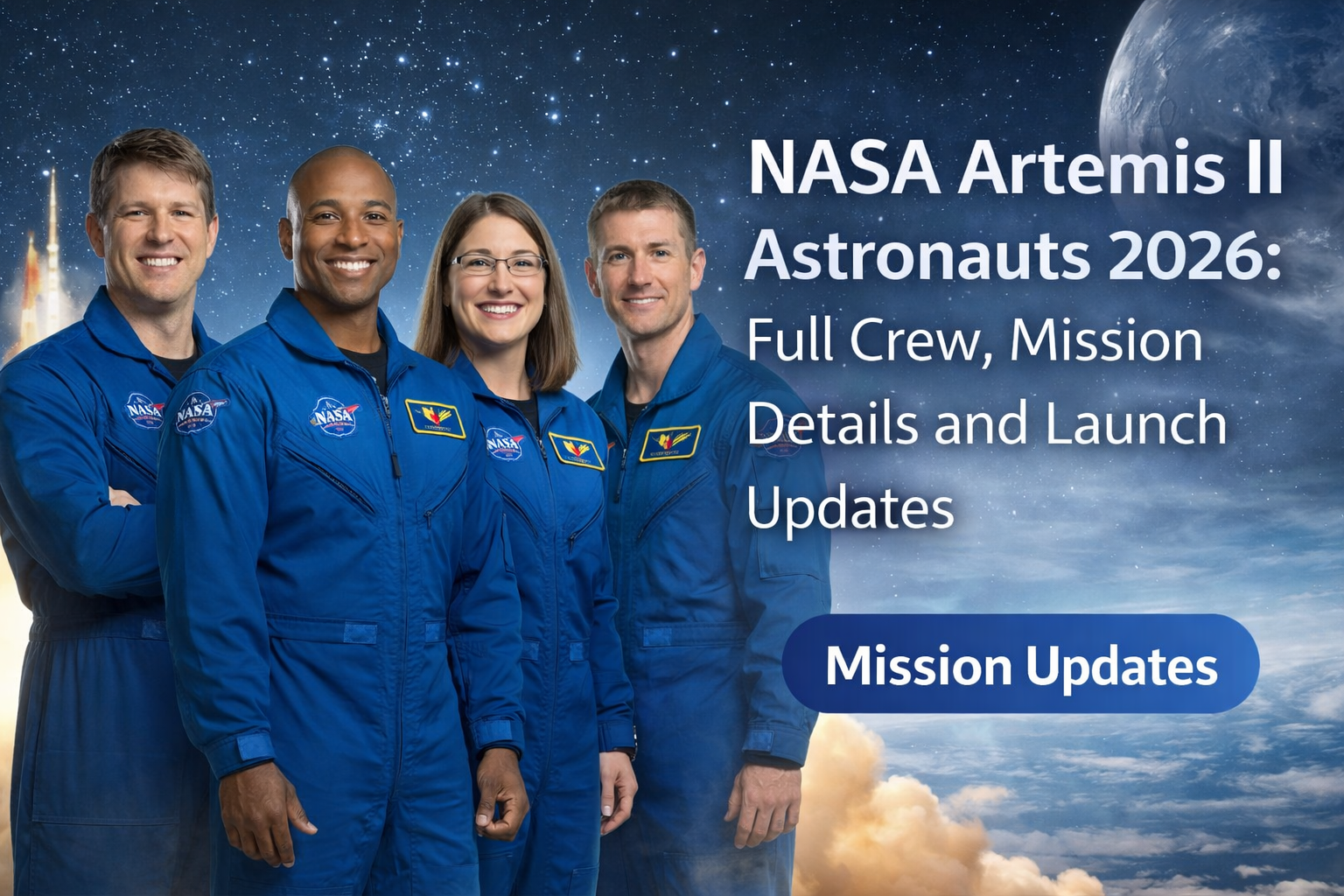
NASA Artemis II Astronauts 2026 — The Complete Story of the Historic Crew that Flew Humanity Back to the Moon: Reid Wiseman, Victor Glover, Christina Koch, and Jeremy Hansen
On April 1, 2026, at exactly 6:35 p.m. EDT, humanity returned to the Moon. Not to land — not yet — but to do something that had not been done in over half a century: to send human beings into deep space, beyond the safety of Earth orbit, and into the ancient neighborhood of our nearest celestial neighbor. NASA's Artemis II mission lifted off from Launch Pad 39B at Kennedy Space Center in Florida aboard the Space Launch System (SLS) rocket — the most powerful rocket ever flown — with the Orion spacecraft named "Integrity" riding on top, and inside it, four extraordinary human beings who had prepared for this moment for nearly three years together.
The crew of Artemis II is historic in every sense of the word. Commander Reid Wiseman, a U.S. Navy test pilot and former Chief of the Astronaut Office, became at age 50 the oldest human being ever to travel beyond low Earth orbit. Pilot Victor Glover, a Black U.S. Navy captain and fighter pilot, became the first person of color in the history of spaceflight to travel toward the Moon. Mission Specialist Christina Koch, an electrical engineer from North Carolina who already holds the record for the longest single spaceflight by a woman (328 days on the ISS), became the first woman to venture beyond Earth's gravitational sphere on a path to the Moon. And Mission Specialist Jeremy Hansen of the Canadian Space Agency, a former CF-18 fighter pilot and physicist making his very first spaceflight, became the first non-American in history to travel to the vicinity of the Moon.
Together, this crew broke Apollo 13's 56-year-old record for the farthest distance any human beings have ever been from Earth, reaching a peak distance of 252,756 miles (406,771 km) from home during their lunar flyby on April 6. They photographed the Moon from its far side, observed a solar eclipse from behind the lunar limb, watched their home planet rise and set from an angle no human had witnessed since the early 1970s, and carried with them the zero-gravity indicator "Rise" — a small stuffed toy mascot designed by an 8-year-old boy from California, depicting the Moon wearing Earth as a baseball cap — that floated freely inside the crew cabin as a sign that they had reached weightlessness.
On April 10, 2026, at 8:07 p.m. EDT, Orion splashed down off the coast of San Diego, completing a nearly 10-day mission that tested the systems and hardware needed to send future crews to the lunar surface, laid the groundwork for the Artemis III landing mission, and reminded the world that human beings are still capable of doing extraordinary things when they work together with discipline, courage, and wonder. The four astronauts returned to NASA's Johnson Space Center in Houston on April 11 — to cheering crowds, emotional press conferences, and the quiet knowledge that they had done something no one alive had done before them.
This is their story.
The Artemis Program — Why Artemis II Mattered More Than Any Moon Mission Since 1972
To understand the significance of the Artemis II crew and their mission, it is necessary to understand the broader program that sent them to the Moon — and why this mission represented a genuinely transformative moment in the history of human spaceflight, not merely a repetition of what was done 50 years ago.
From Apollo to Artemis — 54 Years Between Lunar Crews
The last time human beings traveled to the vicinity of the Moon was December 1972, when Gene Cernan, Harrison Schmitt, and Ron Evans completed the Apollo 17 mission. Cernan was the last human being to walk on the lunar surface — a fact that has haunted spaceflight enthusiasts and policy makers for five decades as subsequent ambitions to return gave way to budget pressures, geopolitical shifts, and the formidable technical and financial challenges of deep space exploration. Forty-three different administrations across six decades of American politics debated, funded, defunded, redesigned, and reimagined the next Moon mission — but none delivered, until Artemis.
Artemis I — The Uncrewed Test (2022)
The Artemis program's first milestone was Artemis I, an uncrewed test flight of the SLS rocket and Orion spacecraft that launched in November 2022 and flew a 25-day mission around the Moon and back. The mission tested the heat shield — which showed some unexpected but ultimately manageable wear — validated the rocket's performance, and confirmed that Orion could survive the thermal and radiation environment of deep space. Artemis I was the essential proof of concept that Artemis II could proceed with crew aboard.
Artemis II — The Crewed Test Flight
Artemis II was defined from the beginning as a crewed test flight rather than a landing mission. The objectives were not to walk on the Moon but to verify that all of Orion's systems function as designed with human beings aboard in the actual deep space environment — life support, navigation, propulsion, power, thermal management, crew interfaces, and emergency procedures. This distinction matters: Artemis II established the confidence and data that future crews will need to actually land on the surface. It was, in the analogy that NASA officials and space historians used repeatedly, the Apollo 8 of the Artemis era — the first crewed voyage to lunar space that would open the door to the landing that follows.
The mission profile
Artemis II followed a free-return trajectory around the Moon — a path similar to Apollo 13's in 1970, designed so that Orion would return to Earth naturally without requiring a propulsion burn, providing an important safety margin for the crew. The trajectory took them approximately two days to reach lunar space, a swing around the far side of the Moon during the April 6 flyby, and approximately three days of return trajectory before splashdown. Total mission duration: 9 days and approximately 9 hours.
Commander Reid Wiseman — The Man Who Led Humanity Back to the Moon
The commander of Artemis II is a man whose life has been defined by two qualities that rarely coexist in equal measure: exceptional professional competence and profound personal humility. Reid Wiseman brought both to the Moon.
Early life and military career
Gregory Reid Wiseman was born on November 11, 1975, in Baltimore, Maryland. As a child, attending a Space Shuttle launch in person sparked a fascination with rockets that never left him. He pursued a Bachelor of Science degree from Rensselaer Polytechnic Institute in Troy, New York, and a Master of Science in Systems Engineering from Johns Hopkins University in Baltimore. Designated a Naval Aviator in 1999, he deployed twice to the Middle East as a U.S. Navy fighter pilot, with a second deployment in 2003. He became a test pilot — one of the most demanding and selective specializations in military aviation — and logged extensive flight hours in high-performance aircraft.
Selection as NASA astronaut and ISS mission
Wiseman was selected in June 2009 as one of nine members of NASA's 20th astronaut class. His first spaceflight was as Flight Engineer aboard the International Space Station for Expedition 40/41 (May 29 – November 9, 2014) — a 165-day mission during which he and his crewmates set a record for 82 hours of scientific research in a single week. He developed a devoted social media following during the mission by sharing the raw emotion of spaceflight through photos, tweets, and short videos. He later served as the 17th Chief of the Astronaut Office from 2020 to 2022.
Personal loss — The death of Carroll Wiseman
In 2020, Reid Wiseman's wife of 17 years, Carroll Taylor Wiseman, died of cancer, leaving him as a single parent to their two daughters. His NASA biography notes that he "considers his time as an only parent as his greatest challenge and the most rewarding phase of his life." This personal context makes one of the most touching moments of the Artemis II mission all the more significant: during the lunar flyby, Hansen announced to Mission Control that the crew wanted to name a crater they had observed "Carroll," in honor of Wiseman's late wife. Hansen's voice quavered as he made the announcement; the four crew members hugged, and Wiseman was seen wiping away a tear. The proposal was officially submitted to the IAU.
Artemis II — The oldest human to travel beyond low Earth orbit
On April 1, 2026, at age 50, Reid Wiseman became the oldest human being in history to travel beyond low Earth orbit — and the first person to command a lunar mission since Gene Cernan on Apollo 17. He monitored the launch from the left seat of Orion at the primary controls. After the mission, he had spent a total of 175 days in space across his two flights.
Pilot Victor Glover — The First Person of Color to Travel to the Moon
Victor Glover brought to Artemis II a history-making presence and a personal philosophy of service that made him one of the most compelling figures in American space exploration in decades.
Growing up and military career
Victor J. Glover Jr. was born and raised in Pomona, California. He earned a Bachelor of Science from California Polytechnic State University, San Luis Obispo, and Master of Science degrees in Flight Test Engineering from the U.S. Naval Test Pilot School and in Systems Engineering from the Naval Postgraduate School and Air University. In the U.S. Navy, he became a distinguished Naval Aviator and test pilot, logging over 3,000 flight hours in 40 different types of aircraft and flying 24 combat missions. He is a captain in the U.S. Navy.
Selection and ISS mission
Glover was selected in NASA's 2013 astronaut class and completed training in 2015. His first spaceflight was aboard SpaceX's Crew Dragon on Crew-1 — the first operational mission to the ISS that SpaceX flew for NASA — launching in November 2020 and returning to Earth in May 2021, spending a total of 168 days in orbit. During that mission, he became the first Black astronaut to live on the ISS for a long-duration assignment and participated in four spacewalks.
The weight of history — A personal ritual
Before any launch, Victor Glover makes it a point to listen to two songs: Gil Scott-Heron's "Whitey on the Moon" and Marvin Gaye's "Make Me Wanna Holler." He has described these as songs from the white-dominated Apollo era of spaceflight that "capture what we did well, what we did poorly." This ritual is a deliberate act of historical memory — an acknowledgment that the achievements of the Apollo era were built on an America that excluded Black citizens from much of its civic and professional life. Glover has consistently framed his place on Artemis II as a "force for good" and a chance to inspire future generations from communities historically underrepresented in space exploration. He prepared his four daughters carefully for the launch — spending, by his own account, more time preparing them than preparing himself.
The first person of color to travel to the Moon
On April 1, 2026, Victor Glover became the first person of color in the history of spaceflight to travel beyond Earth orbit toward the Moon — one of the most significant milestones in the 65-year history of human spaceflight. His presence in the Orion spacecraft as it swung around the Moon represented a genuine expansion of who gets to explore the universe on behalf of humanity.
Mission Specialist Christina Koch — The First Woman to Venture Beyond Earth Orbit
Christina Koch's path to Artemis II is one of the most remarkable in NASA history — a journey from the bottom of the Earth to the edge of the solar system that testifies to the depth of preparation and determination behind every astronaut who flies.
Education and early career
Christina Hammock Koch was born in Grand Rapids, Michigan, and grew up in Jacksonville, North Carolina. She earned dual Bachelor of Science degrees in Electrical Engineering and Physics from North Carolina State University, followed by a Master of Science in Electrical Engineering. Before her astronaut career, she worked as a field engineer at several remote research stations — including the South Pole, where she spent extended time in one of the most isolated and extreme environments on Earth. This experience prepared her psychologically and practically for the challenges of long-duration spaceflight in ways that few other career paths could have.
The record-breaking ISS mission
Selected as a NASA astronaut in 2013, Koch launched to the ISS on March 14, 2019, as part of Expedition 59, and remained in space through Expedition 61, returning to Earth on February 6, 2020. Her total time in space on that mission: 328 days — the record for the longest single spaceflight by a woman in history. During her mission, Koch was part of the first all-female spacewalk alongside Jessica Meir, an event that drew worldwide attention. Her record-setting mission was specifically designed to study the physical, biological, and mental effects of long-duration spaceflight on women — data essential for planning future deep space missions where women would inevitably be part of the crew.
The first woman to travel toward the Moon
On April 1, 2026, Christina Koch became the first woman in history to travel beyond Earth's gravitational sphere toward the Moon. Shortly after launch, she and Jeremy Hansen unstrapped from their seats to set up and test essential life support systems aboard the spacecraft, including the water dispenser, firefighting masks, and toilet. During their lunar flyby on April 6, Koch was photographed peering out of one of Orion's main cabin windows, looking back at Earth from behind the Moon — an image that circulated widely as one of the most powerful photographs of the Artemis program. The image of a woman looking back at Earth from the Moon's neighborhood captured something that no image from the Apollo era ever could: a different kind of astronaut, representing a wider humanity.
Mission Specialist Jeremy Hansen — The First Canadian and Non-American to Fly to the Moon
Jeremy Hansen's presence on Artemis II represents not just a personal milestone but a reflection of the international nature of the Artemis program and of humanity's collective aspiration for space exploration.
From a Canadian farm to fighter pilot to astronaut
Jeremy Hansen grew up on a farm in rural Ontario, Canada — a background that, like Reid Wiseman's Nebraska roots, gave him a practical, grounded sensibility that he carried into the astronaut corps. He joined the Royal Canadian Air Force and became a pilot of CF-18 fighter aircraft, serving in combat-ready squadrons and accumulating extensive experience in high-performance military aviation. From 2004 to 2009, he served as a CF-18 fighter pilot with multiple tactical fighter squadrons. He holds a Bachelor of Science from the Royal Military College of Canada and a Master of Science in Physics from the same institution — making him one of the relatively rare astronauts who combine both military and scientific credentials at a high level.
Selection and pre-Artemis II career
Hansen was selected by the Canadian Space Agency in 2009 as part of the CSA's astronaut selection program. His presence on Artemis II was the direct result of a 2020 treaty between the United States and Canada that provided Canadian astronauts with seats on Artemis missions in exchange for Canada's contribution of Canadarm3 — the powerful robotic arm that will be a key component of the Gateway space station planned for lunar orbit. In 2017, Hansen became the first Canadian to be entrusted with leading a NASA astronaut class, supervising the training of astronaut candidates from both the U.S. and Canada. Artemis II was his first spaceflight.
The first non-American in lunar space
On April 1, 2026, Jeremy Hansen became the first non-American in history to travel to the vicinity of the Moon — a milestone that underscores the international dimension of the Artemis program and the shift away from the purely American character of the Apollo missions. Hansen was 50 years old at the time of the mission — the same age as commander Reid Wiseman. It was one of the most touching moments of the mission when Hansen, his voice quavering with emotion, announced to Mission Control that the crew wanted to name a crater "Carroll" in honor of Wiseman's late wife. "It's a bright spot on the Moon and we would like to call it Carroll," Hansen said, before the four crew members embraced.
The Artemis II Mission — Ten Days Around the Moon and Back
The Artemis II mission lasted approximately 9 days and 9 hours, from launch on April 1 to splashdown on April 10, 2026. Every day brought new milestones, discoveries, and moments that will be studied and remembered for decades.
Launch Day — April 1, 2026
The SLS lifted off from Launch Complex 39B at Kennedy Space Center at exactly 6:35 p.m. EDT on April 1, 2026. The twin solid rocket boosters ignited first, delivering more than 75% of the thrust needed to lift the 5.75-million-pound rocket off the pad. Combined with the four RS-25 engines already at full thrust, the vehicle generated 8.8 million pounds of force at liftoff — making it the most powerful rocket launch in American history. The flight was fully automated and proceeded without requiring any crew intervention, though commander Wiseman monitored the launch from the primary controls and would have been able to issue an abort command if necessary.
Immediately after liftoff, all four solar array wings of the Orion European Service Module deployed fully, giving the spacecraft a wingspan of roughly 63 feet and beginning to draw solar power. Mission Control confirmed the deployment within minutes of launch.
Flight Days 1–3 — Earth Orbit, Translunar Injection, and Deep Space Entry
After launch, the Orion spacecraft entered a highly elliptical Earth orbit. A perigee raise burn on April 2 refined the trajectory and placed Orion in a stable high Earth orbit aligned with its path to the Moon. The translunar injection burn, scheduled for 7:49 p.m. EDT on April 2, lasted 5 minutes and 49 seconds, producing a change in velocity of 1,274 feet per second and sending the crew out of Earth orbit toward the Moon for the first time since 1972.
During these early mission days, the crew conducted manual spacecraft operations tests, evaluated Orion's life-support systems, checked the water dispenser and toilet, and monitored the spacecraft's propulsion and navigation systems. On Flight Day 4, Mission Control woke the crew with Chappell Roan's "Pink Pony Club" — though the crew complained that the song was cut off before the chorus, prompting Mission Control's amused response.
Flight Day 6 — The Lunar Flyby
The emotional apex of the mission came on April 6, 2026, during the lunar flyby. As Orion swung around the Moon, the crew broke Apollo 13's 56-year-old record, reaching a maximum distance from Earth of 252,756 miles (406,771 km). They photographed the lunar surface from orbit, observing craters and geological features from distances and angles impossible from Earth. It was during this flyby that Hansen made his moving announcement about naming a crater "Carroll" after Wiseman's late wife.
The crew also experienced a solar eclipse as Orion passed behind the Moon, with the Sun blocked by the lunar disk for 57 minutes. They donned eclipse glasses as a precaution during the transition, then observed the solar corona, "impact flashes" from meteoroids hitting the Moon's dark side, and multiple planets — Venus, Mars, Saturn, and Mercury — visible alongside the corona. Earthset — the Earth disappearing below the lunar horizon as seen from the spacecraft window — was captured photographically and became one of the iconic images of the Artemis program.
Flight Day 7 — Exiting Lunar Space
Following the flyby, Orion exited the Moon's sphere of influence on April 7 and began its return trajectory to Earth. The crew conducted a 15-minute audio-only call with the Expedition 74 crew aboard the International Space Station — a ship-to-ship communication linking two of humanity's current outposts in space across an unprecedented distance. On Flight Day 8, a planned manual control test was canceled to allow engineers to gather data on a small helium leak in the European Service Module propulsion system; the leak did not affect mission safety.
Splashdown — April 10, 2026
On April 10, 2026, Orion conducted its final trajectory correction burn, then jettisoned the European Service Module before reentry. During reentry, NASA lost contact with the spacecraft for six minutes due to plasma interference — an expected but nerve-inducing blackout. After emerging from the blackout, the spacecraft deployed its drogue parachutes near 22,000 feet and its three main parachutes around 6,000 feet, slowing to a safe speed for splashdown off the coast of San Diego at 8:07 p.m. EDT. Recovery teams from the USS John P. Murtha retrieved the crew by helicopter within two hours. All four astronauts were in good health and returned to Johnson Space Center on April 11.
Historic Firsts and the Legacy of Artemis II
The Artemis II mission produced a constellation of historic firsts that will define its place in the history of human spaceflight for generations.
Records broken and history made
- First crewed lunar mission since Apollo 17 (December 1972) — a gap of more than 53 years
- Record farthest humans from Earth — 252,756 miles, breaking Apollo 13's record of 248,655 miles set in 1970
- First woman (Christina Koch) to travel beyond Earth orbit toward the Moon
- First person of color (Victor Glover) to travel beyond low Earth orbit in the direction of the Moon
- First non-American (Jeremy Hansen) to venture to the vicinity of the Moon
- Oldest human (Reid Wiseman, age 50) to travel beyond low Earth orbit
- Most people in deep space simultaneously since Apollo 8 set the record at three in 1968 — Artemis II carried four
- First crewed flight of the Orion spacecraft
- First crewed flight of the Space Launch System (SLS) Block 1
Science and technology objectives met
Beyond the historic human milestones, Artemis II achieved all primary technical objectives. The crew verified Orion's life-support, propulsion, power, thermal, and navigation systems in the deep space environment. They conducted proximity operations activities, assessed crew habitability, performed lunar surface observations, and participated in science activities including the AVATAR investigation using organ-on-a-chip devices to study radiation and microgravity effects on human health. The helium leak data collected during Flight Day 8 is expected to inform propulsion modifications for future Artemis missions.
What comes next — Artemis III
The Artemis III mission — expected to launch sometime later in 2027 — will build directly on the data and confidence generated by Artemis II. It will test rendezvous and docking capabilities between Orion and SpaceX's Human Landing System (HLS) in lunar orbit, and will put the first woman and the first person of color on the surface of the Moon. The lessons learned by the Artemis II crew in the Orion spacecraft — about its systems, its habitability, its performance in deep space — will be directly incorporated into the preparation and execution of that landing mission.
The Orion Spacecraft "Integrity" — Home for Ten Days in Deep Space
The Orion spacecraft that carried the Artemis II crew was named "Integrity" by the astronauts themselves — a choice that reflected both the technical precision required for deep space exploration and the personal values the crew brought to the mission. The spacecraft had the internal volume of a large van, in which four human beings lived, worked, ate, slept, exercised, and used the toilet for nearly ten days while traveling farther from Earth than any human beings in history.
Technical specifications
Orion is the largest spacecraft ever built for human deep space missions. It consists of a crew module and a European Service Module (ESM) built by the European Space Agency. The crew module provides pressurized living space for four astronauts; the ESM provides propulsion, power via four solar array wings (wingspan approximately 63 feet when deployed), thermal control, and water and oxygen storage. During Artemis II, the crew had access to 189 unique menu items including tortillas, nuts, barbeque beef brisket, cauliflower, macaroni and cheese, butternut squash, cookies, and chocolate.
The zero-gravity indicator "Rise"
NASA selected a zero-gravity indicator for Artemis II through a public design challenge that drew more than 2,600 submissions from over 50 countries. At a pre-launch ceremony on March 27, 2026, Christina Koch announced the winner: "Rise," designed by 8-year-old Lucas Ye of Mountain View, California. Inspired by the Apollo 8 "Earthrise" photograph, the mascot depicts the Moon wearing Earth as a baseball cap. The toy was tethered inside Orion's crew cabin and floated freely once the spacecraft reached weightlessness — a beloved tradition that dates back to early crewed space missions and which the Artemis II crew embraced with evident delight.
Frequently Asked Questions About NASA Artemis II and Its Astronauts (FAQ)
Who were the astronauts on the Artemis II mission?
The Artemis II crew consisted of four astronauts: Commander Reid Wiseman (NASA, U.S. Navy Captain), Pilot Victor Glover (NASA, U.S. Navy Captain), Mission Specialist Christina Koch (NASA), and Mission Specialist Jeremy Hansen (Canadian Space Agency). The crew was announced on April 3, 2023 and trained together for nearly three years before launching on April 1, 2026.
When did Artemis II launch and splash down?
Artemis II launched on April 1, 2026, at 6:35 p.m. EDT from Launch Complex 39B at Kennedy Space Center in Florida. The mission splashed down on April 10, 2026, at approximately 8:07 p.m. EDT off the coast of San Diego, California, with crew recovery conducted by the USS John P. Murtha. Total mission duration was approximately 9 days and 9 hours.
How far from Earth did the Artemis II crew travel?
During their lunar flyby on April 6, 2026, the Artemis II crew set a new record for the greatest distance any human beings have ever been from Earth: 252,756 miles (406,771 km). This broke the previous record of 248,655 miles (400,171 km) set by the Apollo 13 crew in April 1970.
What historic firsts did Artemis II achieve?
Artemis II set multiple historic records: it was the first crewed lunar mission since Apollo 17 in December 1972; Victor Glover became the first person of color to travel beyond low Earth orbit; Christina Koch became the first woman to travel toward the Moon; Jeremy Hansen became the first non-American to fly to the vicinity of the Moon; and Reid Wiseman, at age 50, became the oldest human to travel beyond low Earth orbit. The mission also carried four people into deep space simultaneously — the most since Apollo 8 carried three in 1968.
Did the Artemis II crew land on the Moon?
No. Artemis II was a crewed test flight, not a landing mission. The spacecraft flew a lunar flyby — swinging around the Moon without entering lunar orbit or descending to the surface. The mission's primary objective was to verify that all of Orion's systems function correctly with crew aboard in the deep space environment. The lunar landing mission — Artemis III — is expected to launch later in 2027, building on the data and experience gathered by Artemis II.
What was the Orion spacecraft named by the Artemis II crew?
The Artemis II crew named their Orion spacecraft "Integrity." The choice reflected the precision and reliability required for deep space exploration and the personal values the four crew members brought to their mission. The zero-gravity indicator chosen for the mission was "Rise," a stuffed toy mascot designed by 8-year-old Lucas Ye of Mountain View, California, depicting the Moon wearing Earth as a baseball cap, inspired by the Apollo 8 "Earthrise" photograph.
What happens after Artemis II?
Artemis III, targeted for launch later in 2027, will build on the Artemis II data to conduct the first crewed lunar landing since Apollo 17. Artemis III will test rendezvous and docking between Orion and SpaceX's Human Landing System in lunar orbit, then land two astronauts — including the first woman and first person of color — on the lunar surface. The Lunar Gateway space station program was canceled in March 2026, streamlining the path toward surface missions. NASA's long-term vision includes using the Moon as a proving ground and resupply point for eventual crewed missions to Mars, targeted for the late 2030s to early 2040s.
Conclusion — The Artemis II Crew and the New Age of Human Exploration
When Orion splashed down in the Pacific Ocean off San Diego on the evening of April 10, 2026, something important happened to the human relationship with the universe. After more than half a century during which no living human being could claim to have traveled beyond the gravitational embrace of their home planet, there were suddenly — briefly — four such people. And when they splashed down and were recovered from the ocean and flew home to Houston, they carried with them data, photographs, memories, and a confirmed proof of concept: that human beings can still do this. That the capability built over decades of engineering and training and international cooperation is real, not theoretical. That the Moon is not a destination from humanity's past but from its future.
The Artemis II crew — Reid Wiseman, Victor Glover, Christina Koch, and Jeremy Hansen — each brought something irreplaceable to this mission. Wiseman brought the quiet authority of a man who had already led the astronaut corps and who grieved and parented and persevered through personal loss on the way to command. Glover brought the weight of history, the consciousness of representing a community that had been denied this frontier for generations, and the determination to be — in his own words — a "force for good." Koch brought the deepest experience of long-duration spaceflight any member of the crew possessed, and the distinction of being the first woman to look back at Earth from the Moon's neighborhood. And Hansen brought Canada and the world — the reminder that humanity's next steps beyond Earth orbit are not the property of any one nation but of our species as a whole.
Together, they flew to the Moon. They went farther from home than any humans in history. They named a crater after a woman who didn't live to see this day. They looked back at Earth from the window of a spacecraft called "Integrity" and photographed a small blue marble floating in absolute darkness. And then they came home, safely, to tell the rest of us what they saw.
The next mission lands.
Sources: NASA.gov, Wikipedia, Britannica, Space.com, ABC News, Euronews, Air and Space Museum — all data verified and updated April 11, 2026.