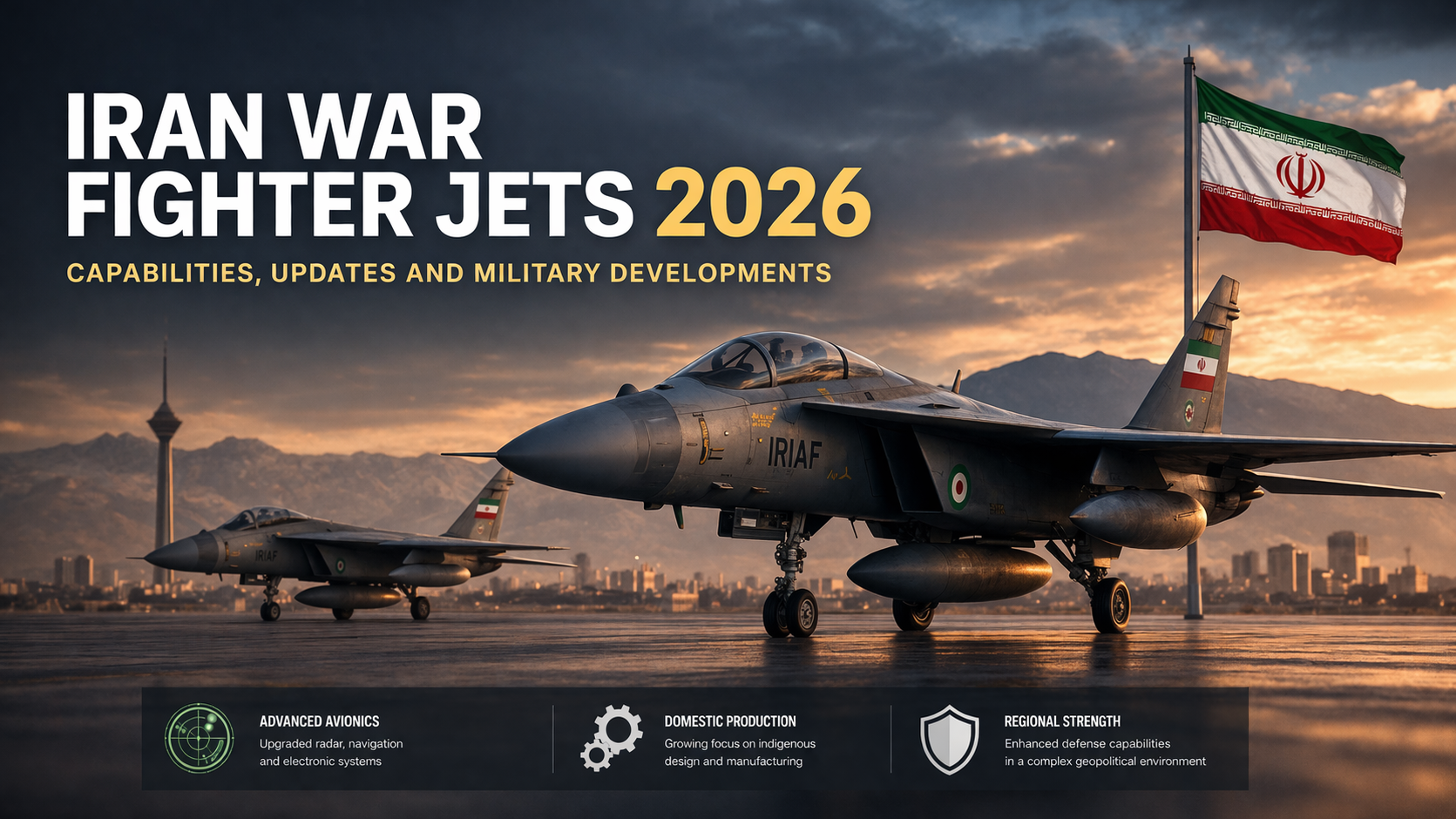
Iran War Fighter Jets 2026 — Complete Guide: US Aircraft Lost, Iranian Air Force Fleet, Operation Epic Fury and the Aerial Battle Over the Persian Gulf
⚠️ Editorial Note: This article covers an active, ongoing military conflict. All information is drawn from verified reports by major news organizations (CNN, NBC News, Al Jazeera, Military Times, Defense One, Reuters, AFP) as of April 4, 2026. The situation is rapidly evolving. Figures and developments will change. This article is intended for informational and analytical purposes only.
Since the launch of Operation Epic Fury on February 28, 2026, the skies above Iran, the Persian Gulf, and the broader Middle East have become the stage for one of the most intense aerial campaigns the world has witnessed in decades. At the heart of this conflict lies a brutal arithmetic: the United States and Israel — operating the most advanced fighter jets, stealth bombers, and precision-guided munitions ever fielded — have been systematically striking Iranian military targets, nuclear facilities, and industrial infrastructure. Iran, fielding a fighter jet fleet that is largely composed of American-made aircraft acquired before the 1979 Islamic Revolution, has responded with a combination of surface-to-air missile systems, domestically developed drones, and unconventional tactics that have, in several significant instances, succeeded in shooting down US aircraft.
The Iran war fighter jets story in 2026 is therefore not a simple narrative of overwhelming US air power crushing a helpless adversary. It is a far more nuanced, dangerous, and unpredictable contest — one in which a relatively antiquated air force, combined with advanced air defense networks and a massive fleet of cheap attack drones, has managed to inflict real losses on the most powerful military in the world. As of April 4, 2026, at least seven US manned aircraft have been downed during the conflict, the most recent and dramatic being a US Air Force F-15E Strike Eagle shot down over southwestern Iran on April 3, 2026, with a search and rescue mission still underway for a missing crew member.
This comprehensive guide covers every dimension of the aerial war over Iran in 2026: the full inventory of Iranian Air Force fighter jets, the role of each aircraft type in the conflict, the sequence of US aircraft losses, the strategic logic of Operation Epic Fury, the revolutionary impact of Iranian drone warfare on the balance of air power, the underground air bases designed to protect Iran's fleet from preemptive strikes, the Russian-supplied Su-35 deal that was supposed to transform Iran's capabilities, and the broader strategic implications of a conflict that is reshaping the geopolitics of the Middle East and the global energy market. This is the most detailed and up-to-date analysis of the air war over Iran available anywhere.
Operation Epic Fury — The Air Campaign That Started It All
Operation Epic Fury, launched on February 28, 2026, is the name given by US Central Command (CENTCOM) to the combined US-Israeli military operation targeting Iran's nuclear program, military infrastructure, and air defense network. The operation began approximately eight months after the June 2025 Twelve-Day War, in which the Israeli Air Force (IAF) had already significantly degraded Iran's air defense capabilities and destroyed several of its nuclear facilities using B-2 Spirit stealth bombers and Tomahawk cruise missiles.
The Strategic Objective
The stated objective of Operation Epic Fury is the permanent elimination of Iran's nuclear weapons development capacity and the degradation of the Islamic Revolutionary Guard Corps (IRGC) military infrastructure to the point where it can no longer threaten regional stability. US and Israeli planners had determined that the June 2025 strikes, while significant, had not fully achieved the objective — Iran's nuclear program had been set back but not destroyed, and the IRGC had rapidly rebuilt its drone and missile capabilities using dispersed, hardened facilities across the country.
The first 100 hours of Operation Epic Fury cost approximately $3.7 billion, or roughly $891 million per day, according to the Center for Strategic and International Studies — making it one of the most expensive opening phases of any US military operation since the 2003 invasion of Iraq. This figure reflects the extraordinary density of precision-guided munitions, stealth aircraft sorties, and naval strike assets deployed in the opening hours of the campaign.
The Opening Strikes — Nuclear Facilities and Air Defense Networks
The opening phase of Operation Epic Fury focused on two priority target sets: Iran's air defense infrastructure (to enable subsequent strikes with less risk to US aircraft) and its nuclear enrichment facilities. US B-2 Spirit stealth bombers, flying from Whiteman Air Force Base in Missouri, struck hardened underground facilities using Massive Ordnance Penetrator (MOP) bunker-buster bombs. F-35A and F-35B stealth fighters conducted Suppression of Enemy Air Defenses (SEAD) missions against Iranian radar installations, surface-to-air missile (SAM) batteries, and command and control nodes. The campaign against Iranian air defenses was initially declared largely successful by senior US officials, including President Trump, who claimed in a primetime White House address that the US had "completely eliminated" Iranian anti-aircraft facilities — a claim that subsequent events would prove significantly overstated.
US Fighter Jets in the Iran War — Types, Roles and Losses
The United States has deployed a wide range of combat aircraft to Operation Epic Fury, reflecting the full spectrum of the US Air Force, Navy, and Marine Corps aviation inventories. Understanding which aircraft are playing which roles — and which have been lost — is essential to understanding the dynamics of the air war.
The F-15E Strike Eagle — The Workhorse and the Casualty
The Boeing F-15E Strike Eagle is a two-seat, dual-role fighter-bomber and the most consequential aircraft in the narrative of the Iran war's aerial battles. It is the jet that has featured most prominently in the conflict's losses. The F-15E, developed in the 1980s as an evolution of the air superiority F-15C, is designed for deep precision strike missions against ground targets in all weather conditions while retaining significant air-to-air combat capability. With a combat radius exceeding 1,000 kilometers and the ability to carry a wide array of precision-guided munitions, the F-15E has been the primary platform for strike missions deep into Iranian territory.
The most significant single event of the air war to date occurred on April 3, 2026, when Iranian forces shot down a US F-15E Strike Eagle over southwestern Iran. The aircraft was from the 48th Fighter Wing, 494th Fighter Squadron, based at RAF Lakenheath in Suffolk, England. Iranian state media published photos of the wreckage, including images of the tailfin bearing the red stripe characteristic of the 48th Fighter Wing's aircraft, which aviation experts consulted by NBC News confirmed were "consistent with an F-15." Iran also published what it claimed was the Advanced Concept Ejection Seat from the downed aircraft.
One of the two crew members was rescued by US forces and is receiving medical attention. The other crew member's fate remains unknown as of the time of writing, with a massive search and rescue operation underway, involving HC-130 tanker aircraft and HH-60G Pave Hawk helicopters seen operating at low altitude over southwestern Iran. Iranian authorities offered a bounty for captured US pilots, and Iranian state media broadcast on-screen crawls urging locals to "shoot them if you see them."
Separately, on March 1, 2026, three F-15E Strike Eagles were shot down in a friendly fire incident over Kuwait, struck by a Kuwaiti Air Force F/A-18 Hornet during a confused engagement that occurred while Iranian aircraft, ballistic missiles, and drones were simultaneously attacking the area. All six crew members ejected and were safely recovered. This incident underscored the extreme complexity and danger of operating in a high-density combat environment with multiple nations and weapons systems simultaneously active.
The F-35 Lightning II — Stealth Under Fire
The Lockheed Martin F-35 Lightning II is the US military's primary fifth-generation stealth multirole fighter and has played a central role in the opening SEAD missions of Operation Epic Fury. The F-35's low radar cross-section makes it particularly valuable for penetrating Iranian airspace to target air defense systems before non-stealth aircraft follow in subsequent strike packages.
On March 19, 2026, a US F-35 fighter jet was reportedly hit by Iranian fire during a combat mission over Iran — the first reported hit on a fifth-generation stealth aircraft by Iranian defenses during the conflict. The aircraft was able to make an emergency landing at a US air base in the region and was not destroyed. Iranian state media initially claimed the wreckage belonged to an F-35, but the debris shown in photographs was subsequently identified by aviation experts as consistent with an F-15E, not an F-35.
The A-10 Thunderbolt II — The Warthog Goes to War
The Fairchild Republic A-10 Thunderbolt II, nicknamed the "Warthog," is perhaps the most unexpected participant in the Iran air war. Designed in the 1970s specifically for close air support against Soviet armor in a potential European land war, the A-10 is a slow, relatively low-altitude aircraft that seems ill-suited for combat in heavily defended Iranian airspace. Its deployment in Operation Epic Fury reflects the enormous demand for aircraft capable of providing fire support to ground operations and for conducting strikes against lower-threat targets once the initial air defense suppression campaign has degraded Iranian SAM networks.
On April 3, 2026, an A-10 Thunderbolt II was struck by Iranian fire while supporting the search and rescue operation for the downed F-15E crew. The pilot managed to fly the damaged aircraft to Kuwaiti airspace before ejecting safely; the aircraft crashed in Kuwait. This incident demonstrated that even in a search and rescue context — an operation typically conducted under the protection of extensive cover assets — Iranian forces retained sufficient air defense capability to threaten US aircraft.
The KC-135 Stratotanker — The Non-Combatant Casualty
Not all US aircraft lost in the Iran war have been combat jets. On March 12, 2026, a US Air Force KC-135 Stratotanker aerial refueling aircraft crashed in western Iraq during combat operations, killing all six crew members on board. The KC-135, while not a fighter jet, is an absolutely critical component of any sustained air campaign over Iran: without aerial refueling, US aircraft based in the region could not reach many targets deep inside Iranian territory and return safely. The loss of a tanker, with its full crew, was a stark reminder that the Iran war is not only costing the United States combat aircraft but also support aircraft and the personnel who fly them.
The Iranian Air Force in 2026 — A Fleet Between Eras
To understand the Iranian side of the air war, one must grapple with one of the most paradoxical facts in modern military history: the Islamic Republic of Iran Air Force (IRIAF) is largely equipped with American fighter jets acquired by the Shah's regime before the 1979 Islamic Revolution — aircraft that the United States then stopped supplying with spare parts, upgrades, and technical support after the revolution. For nearly half a century, Iran has maintained these aircraft under increasingly desperate conditions of international sanctions and technological isolation, creating what analysts have dubbed a "flying museum."
The F-14 Tomcat — Iran's Last Remaining Top Gun
The most iconic aircraft in the Iranian arsenal is undoubtedly the Grumman F-14A Tomcat. The United States sold 79 of these legendary air superiority fighters to the Shah's Iran in the 1970s; they were considered among the most capable fighters in the world at the time, and their depiction in the 1986 film Top Gun made them globally famous. After the revolution, the US cut off all spare parts and technical support, leaving Iran to keep its Tomcats flying through reverse engineering, cannibalization, and improvisation.
As of early 2026, Iran is estimated to have roughly 40 to 44 F-14s in various states of operational readiness — a fraction of the original 79. During the June 2025 Twelve-Day War, the Israeli Air Force reportedly destroyed two parked F-14 Tomcats in initial airstrikes, and a subsequent strike the following week destroyed three more. Despite their age and severely degraded condition, the surviving F-14s represent Iran's most capable air-to-air fighters, equipped with the AIM-54 Phoenix long-range missile — the only country other than the United States to have ever operated this weapon system.
The F-4 Phantom II and F-5 Tiger — The Backbone of an Aging Fleet
The McDonnell Douglas F-4 Phantom II and the Northrop F-5 Tiger form the largest portion of Iran's combat aircraft inventory. These 1960s-era designs, of which Iran purchased large numbers under the Shah, are now more than half a century old and represent an extraordinary maintenance challenge. Despite their age, both types continue to fly — the F-4 as a versatile fighter-bomber capable of delivering a range of air-to-ground weapons, and the F-5 as a light fighter and trainer that has also served as the blueprint for Iran's domestic aviation industry.
On March 1, 2026, the Israeli Air Force destroyed an F-5 and an F-4 Phantom II at Tabriz Shahid Madani International Airport in northeastern Iran — among the earliest losses of Iranian aircraft in Operation Epic Fury. On March 2, 2026, US CENTCOM released footage confirming the destruction of two IRGC-affiliated Sukhoi Su-22 "Fitter" strike aircraft on the ground.
These losses, while significant in absolute terms, must be understood in the context of the IRIAF's operational posture: the service had already demonstrated during the Twelve-Day War in June 2025 that its fighter jets rarely if ever left the ground to engage Israeli or American aircraft — a decision driven by the understanding that scrambling aged, unupgraded fighters against fifth-generation stealth aircraft and modern air-to-air missiles would be suicidal. The IRIAF's strategy is one of preservation: keep the fleet alive in hardened facilities, absorb initial losses, and wait for conditions where it can operate without facing overwhelming technological disadvantage.
The Su-24 Fencer and MiG-29 Fulcrum — Soviet-Era Supplements
In addition to its American-origin aircraft, Iran operates a number of Soviet and Russian-designed fighters acquired after the Iran-Iraq War (1980-1988). The Sukhoi Su-24 Fencer, a two-seat swing-wing strike aircraft with genuine deep-strike capability, and the Mikoyan MiG-29 Fulcrum, a capable fourth-generation air superiority fighter, both play roles in the Iranian order of battle.
The most dramatic incident involving Iranian aircraft of this type occurred on March 2, 2026, when two Iranian Su-24 tactical bombers flying at low altitude attempted to strike Al-Udeid Air Base in Qatar and the Ras Laffan Industrial City — the world's largest liquefied natural gas facility. After the Su-24s failed to respond to radio warnings, a Qatari Air Force F-15QA shot both of them down. This engagement marked the first aerial kills ever achieved by the Qatar Emiri Air Force — an extraordinary historical moment buried within the larger drama of the Iran war.
The Domestic Fleet — Iran's Indigenous Fighter Development
Forced by decades of sanctions to develop its own aviation industry, Iran has produced several domestically developed or modified fighter aircraft. The most significant is the HESA Kowsar, a 100% indigenously produced aircraft that is visually nearly identical to the American F-5F but features a modern glass cockpit, digital data networks, and advanced ballistic computers. The Saeqeh (Thunderbolt) and Azarakhsh (Lightning) represent further Iranian efforts to refine the F-5 design into more capable platforms.
These domestically produced fighters, while impressive as engineering achievements given the constraints of sanctions, are not competitive with modern fourth-generation fighters from Russia, China, or the West. Their role in the current conflict is primarily symbolic — demonstrating Iran's technological capability and self-reliance — rather than operationally decisive.
Iran's Underground Air Bases — The "Eagle 44" Strategy
One of the most significant strategic adaptations of the Iranian Air Force in recent years is the construction of a network of underground air bases designed to protect its aircraft from preemptive strikes. The most prominent of these is the "Eagle 44" (Oghab 44) facility, unveiled publicly in 2023 — a massive installation carved deep into the Zagros Mountains of western Iran, designed to house fighter jets, drones, and command and control facilities in tunnels deep enough to withstand bunker-buster bombs.
This strategy reflects a clear-eyed assessment of Iran's military reality: in any conventional air war against the United States and Israel, Iranian aircraft would be extremely vulnerable to preemptive strikes on their surface air bases. By dispersing assets underground, Iran creates a "fleet in being" — a force that may not be able to operate freely in contested airspace, but cannot be easily eliminated in one or two strike packages. This concept, borrowed from naval strategy, forces any adversary planning an attack on Iran to expend enormous resources and risk on striking multiple hardened underground facilities before being able to claim that the Iranian air force has been neutralized.
As of April 2026, the effectiveness of Iran's underground basing strategy in preserving its aircraft is a matter of significant debate among military analysts. Publicly confirmed strikes have destroyed several aircraft on surface bases, but the full extent of underground facility destruction is unknown.
The Su-35 Deal — Russia's Advanced Fighter for Iran
Perhaps the most consequential potential transformation of Iranian air power in recent years is the long-anticipated deal for the Sukhoi Su-35 "Flanker-E" from Russia. After years of speculation and leaked documents, a deal for 48 Su-35s was confirmed as materializing in early 2026. The Su-35 is a 4.5-generation multirole fighter that represents a massive leap in capability over anything currently in the Iranian inventory — offering superior maneuverability, the advanced Irbis-E active electronically scanned array (AESA) radar, and long-range air-to-air missiles including the R-77 and R-37M that far outclass the weapons available on Iran's aging fleet.
To prepare for the Su-35 transition, Iran had already received Yakovlev Yak-130 Mitten advanced jet trainers from Russia — aircraft specifically designed to bridge the gap for pilots transitioning from older aircraft to modern fighters. The first two Yak-130s were delivered in September 2023.
However, the onset of active combat in 2026 has complicated and potentially accelerated the timeline. The war has exposed the catastrophic capability gap facing the IRIAF — particularly after the Twelve-Day War in June 2025, when Iranian fighter jets reportedly never left the ground to intercept Israeli strikes. If the Su-35 deliveries can be accelerated and Iranian pilots can complete their conversion training, these aircraft could significantly alter the air balance in any future phase of the conflict. Some analysts note that Iran has also begun exploring the Chinese J-10C as an alternative or supplement, following the J-10C's reportedly impressive performance in the 2025 India-Pakistan conflict.
Iran's Drone War — The Real Game Changer
While the fighter jet narrative dominates headlines, the most strategically significant aerial development in the Iran war is not the clash of manned aircraft but the extraordinary role of Iranian drones — specifically the HESA Shahed series of one-way attack drones (sometimes called "kamikaze drones" or loitering munitions).
The Cost Equation That Threatens US Air Power
Iran manufactures the Shahed-136 one-way attack drone at a reported cost of approximately $20,000 to $30,000 per unit. The US military's primary response to these drones has involved expensive munitions: PAC-3 Patriot interceptor missiles costing approximately $4 million each, and even fighter jet sorties burning tens of thousands of dollars in fuel and weapons per engagement. As a Center for a New American Security analysis bluntly put it: "Every $30,000 Shahed that forces the U.S. or a partner to fire a $4 million PAC-3 missile is a massive win for Iran — because of the relative cost, and because Iran has far more cheap drones than the U.S. and its partners have expensive interceptors."
This asymmetric economic logic is at the heart of Iran's drone strategy. By launching waves of cheap drones — which can overwhelm air defense systems through sheer numbers — Iran forces the United States and its partners to expend far more valuable resources in defense than Tehran expends in attack. In response, the US Air Force has adapted its own fighter jets to engage drones more cost-effectively, equipping F-15Es and F-16s with the Advanced Precision Kill Weapon System II (APKWS) — a precision-guided rocket costing $25,000 to $40,000, far less than a conventional air-to-air missile.
Drone Effectiveness in Combat
The scale of the drone threat has been immense. CENTCOM Chairman General Dan Caine confirmed that US and allied forces had conducted "intercepts against one-way attack drones using fighters and attack helicopters," but noted this had driven down Iranian drone usage by 83 percent since the start of Operation Epic Fury — a figure that simultaneously reveals the effectiveness of US countermeasures and the initial intensity of the drone campaign. Six US soldiers were killed on March 12, 2026, when a Shahed drone struck a facility in Port Shuaiba, Kuwait, evading air defenses. The US has responded by targeting Iran's drone manufacturing facilities to degrade the supply chain at its source.
The Strait of Hormuz — The Aerial War's Strategic Chokepoint
The air war over Iran cannot be separated from the contest over the Strait of Hormuz — the narrow waterway through which approximately 20 percent of the world's traded oil passes. Iran has placed the strait under what amounts to an effective blockade, controlling access to shipping and creating enormous economic disruption. Iranian air power, particularly its drone and anti-ship missile capabilities, plays a central role in enforcing this blockade. US and allied aircraft have been conducting missions specifically aimed at degrading Iran's anti-ship missile and drone capabilities along the strait's coastline — missions that bring them into close proximity to Iran's most capable remaining air defense systems.
On March 2, 2026, the two Iranian Su-24 bombers destroyed by Qatar were targeting Ras Laffan Industrial City — the world's largest LNG processing facility, located on the Qatari side of the Persian Gulf. A successful strike on this facility would have caused catastrophic damage to global energy markets, highlighting the extent to which the aerial war is inextricably linked to the global economic stakes of the conflict.
The Human Cost — US Personnel Lost in the Air War
As of April 4, 2026, at least 13 US service members have been killed in combat operations against Iran. The losses include:
- Six crew members killed in the KC-135 Stratotanker crash in western Iraq on March 12, 2026
- Six soldiers killed by an Iranian Shahed drone strike at Port Shuaiba, Kuwait on approximately March 20, 2026
- Additional personnel killed in other engagements
- One F-15E crew member still missing following the April 3, 2026 shoot-down
Congressional opposition to the war has grown as the human cost mounts. Democratic Representative Seth Moulton of Massachusetts, a member of the House Armed Services Committee, said on CNN: "They don't know how to get out of this mess. They do not know how to end this war." The congressman accused the commander-in-chief of putting US troops "at grave risk" by claiming air defenses had been completely eliminated when they clearly had not been.
Frequently Asked Questions (FAQ) — Iran War Fighter Jets 2026
What US fighter jets have been shot down over Iran in 2026?
As of April 4, 2026, the confirmed manned US aircraft losses include: one F-15E Strike Eagle shot down by Iranian forces on April 3, 2026 (one crew member rescued, one still missing); three F-15E Strike Eagles destroyed in a friendly fire incident over Kuwait on March 1, 2026 (all six crew members safely recovered); one A-10 Thunderbolt II struck by Iranian fire and crashed in Kuwait after the pilot safely ejected; and one KC-135 Stratotanker that crashed in western Iraq, killing all six crew members. Additionally, an F-35 was reportedly hit on March 19 but made an emergency landing safely. Total manned aircraft losses stand at at least seven.
What fighter jets does the Iranian Air Force fly in 2026?
The Iranian Air Force operates a combination of American-made aircraft from before the 1979 Revolution (F-14 Tomcat, F-4 Phantom II, F-5 Tiger), Soviet-era aircraft (MiG-29, Su-24, Su-22), and domestically developed jets (HESA Kowsar, Saeqeh, Azarakhsh). Iran is also in the process of receiving Russian Su-35 fighters as part of a 48-aircraft deal, and has expressed interest in the Chinese J-10C as an alternative.
What is Operation Epic Fury?
Operation Epic Fury is the name given by US Central Command (CENTCOM) to the combined US-Israeli military campaign against Iran, launched on February 28, 2026. Its stated objectives include the permanent elimination of Iran's nuclear weapons program and the degradation of the IRGC military infrastructure. The first 100 hours of the operation cost approximately $3.7 billion ($891 million per day) according to CSIS estimates.
What happened to the Iranian Air Force during the 2025 Twelve-Day War?
During the June 2025 Twelve-Day War between Israel and Iran, the Islamic Republic of Iran Air Force reportedly did not scramble fighter jets to intercept Israeli strikes, essentially ceding air superiority to the Israeli Air Force without a fight. This allowed Israel to destroy multiple F-14 Tomcats, the IRIAF's only aerial tanker (a KC-707), and various other assets. The IRIAF's failure to engage was driven by an assessment that its aging jets could not survive combat against Israeli F-35s and F-15Is equipped with modern missiles.
Why is Iran's drone strategy so effective against US air power?
Iranian Shahed attack drones cost approximately $20,000-$30,000 each, while the US missiles used to intercept them (such as PAC-3 Patriots) cost approximately $4 million each. This creates a cost asymmetry that systematically favors Iran: every cheap drone that forces an expensive intercept is an economic victory for Tehran. Iran also produces these drones in enormous quantities, potentially overwhelming the finite supply of US interceptor missiles. The US has adapted by using cheaper interceptors (the APKWS guided rocket at $25,000-$40,000) and by using fighter jets to shoot down drones before they reach their targets.
What is Iran's "Eagle 44" underground air base?
Eagle 44 (Oghab 44) is a massive underground air base facility unveiled by Iran in 2023, carved into the Zagros Mountains in western Iran. It is designed to house fighter jets, drones, and command facilities in tunnels deep enough to resist bunker-buster bombs. This facility — part of a broader network of underground bases — allows Iran to preserve aircraft from preemptive strikes and maintain a "fleet in being" even under sustained air attack.
Is Iran receiving Russian Su-35 fighter jets?
Yes. A deal for 48 Sukhoi Su-35 "Flanker-E" advanced 4.5-generation fighters has been confirmed as materializing in 2026. This deal is central to a deepening Russia-Iran strategic partnership — Iran has supplied Russia with Shahed loitering munitions for use in Ukraine, and Russia is providing military hardware including the Su-35 and Yak-130 trainers in return. The Su-35 would represent a massive capability upgrade for the IRIAF, far outclassing anything in its current inventory.
Conclusion — The Air War Over Iran and What Comes Next
The aerial dimension of the Iran war in 2026 is revealing truths about modern air power that will be studied by military strategists for decades. The United States has deployed the most advanced air power in human history — fifth-generation stealth fighters, precision-guided munitions with near-zero circular error probabilities, airborne command and control platforms, and aerial refueling networks that extend the reach of any aircraft to any point on the globe. And yet, an air force composed largely of aircraft designed and built in the 1960s and 1970s, maintained under crushing international sanctions, has managed to shoot down multiple US aircraft — including an F-15E Strike Eagle — forcing a massive search and rescue operation deep inside hostile territory.
This outcome is not a failure of American air power so much as a demonstration of the extraordinary tenacity and adaptability of asymmetric warfare. Iran's combination of underground basing, integrated air defense systems (including domestically developed radar and missile networks), saturation drone tactics designed to overwhelm expensive air defenses, and unconventional engagement methods has created an operating environment that is genuinely dangerous for US aircraft even in a context of overwhelming overall technological superiority.
As the Iran war fighter jet story continues to evolve — with Su-35 deliveries pending, the US adapting its tactics and munitions to the drone threat, and the political and economic pressure of the Strait of Hormuz blockade mounting — the air war over Iran will remain one of the defining military events of the early 21st century. What happens in the skies above the Persian Gulf in the coming weeks and months will shape not only the outcome of this specific conflict, but the doctrine, procurement decisions, and strategic calculations of every air force in the world.
This article will be updated as new verified information becomes available. All figures and developments are current as of April 4, 2026. Sources: CNN, NBC News, Military Times, Defense One, Al Jazeera, Reuters, AFP, Wikipedia (Islamic Republic of Iran Air Force article), Center for Strategic and International Studies.