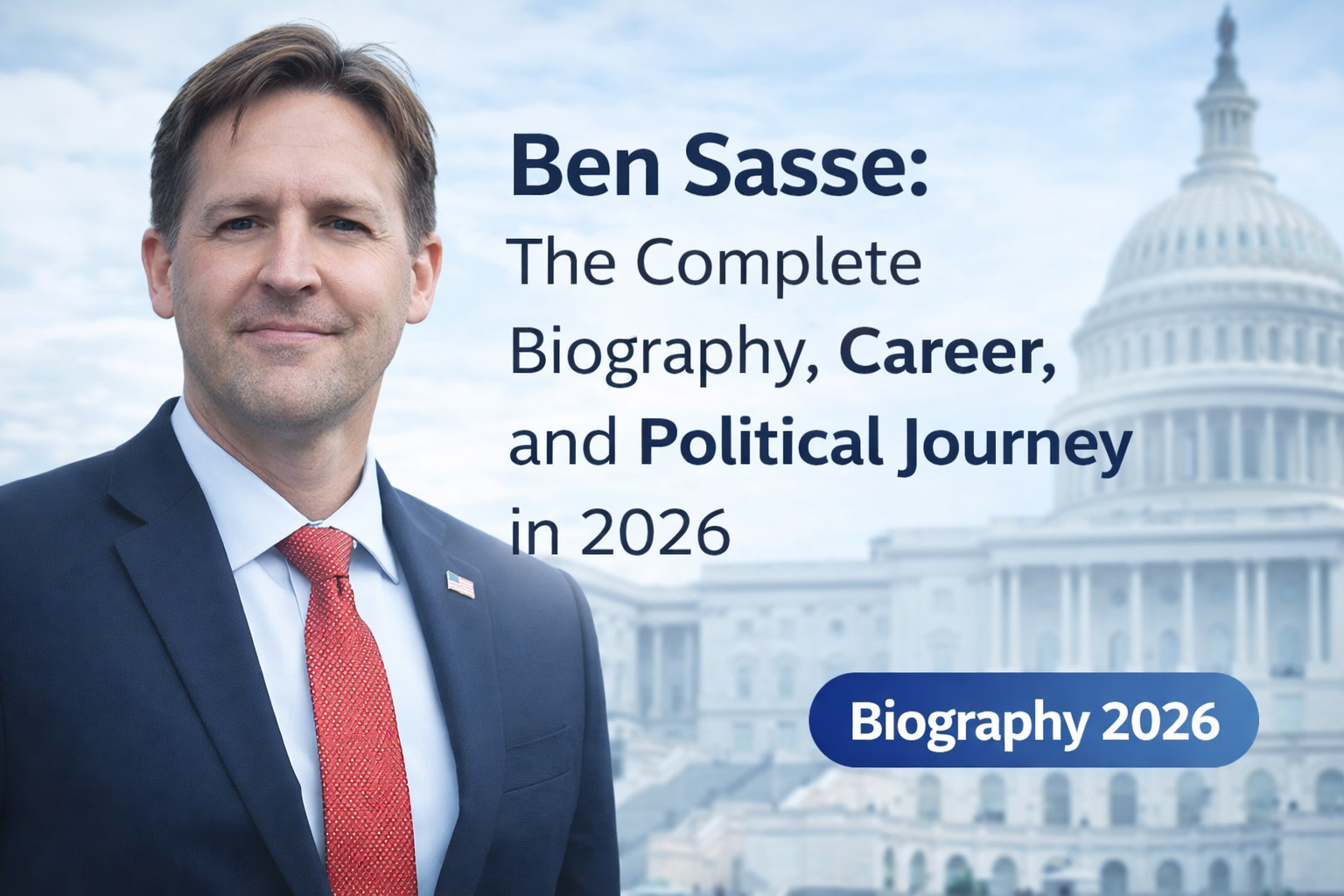
Ben Sasse — The Complete Biography of Nebraska's Maverick Senator: From Harvard to the U.S. Senate, the University of Florida, and Facing Terminal Cancer with Uncommon Grace
In an era when political courage in America has become rarer than gold, Ben Sasse spent nearly a decade as one of the most intellectually honest — and politically inconvenient — voices in the United States Senate. Born in the small Nebraska town of Plainview on February 22, 1972, Benjamin Eric Sasse built a life that defies easy categorization: Harvard undergraduate, Yale historian, McKinsey consultant, college president, two-term Republican senator, university president, and now — with characteristic directness and intellectual honesty — a man facing his own mortality with the same measured clarity he brought to the national debates he helped shape. In December 2025, Sasse announced that he had been diagnosed with stage 4 pancreatic cancer, turning his public platform toward reflections on faith, family, mortality, and what truly matters when time becomes finite and precious.
What made Ben Sasse remarkable in the Senate was precisely what made him uncomfortable for partisans on both sides: he genuinely meant what he said. In a Washington culture that has perfected the art of performing principle while practicing expediency, Sasse was one of the few senators who voted his conviction even when it cost him politically. He was one of seven Republican senators who voted to convict Donald Trump in his second impeachment trial following the January 6, 2021 assault on the Capitol — a vote that made him deeply unpopular with Nebraska's Republican establishment, led to his censure by the state party, and contributed to his eventual decision to leave the Senate in early 2023. His response to the censure remains one of the more memorable formulations in recent American political discourse: "Politics isn't about the weird worship of one dude."
But Ben Sasse's story is not simply the story of a principled Republican who broke with his party. It is the story of a thinker who cared deeply about institutions — about what holds a civilization together when its cultural foundations erode, about what education is really for, about the relationship between technology and loneliness, about why Congress has become a dysfunctional performance rather than a governing body. His two New York Times bestselling books — The Vanishing American Adult (2017) and Them: Why We Hate Each Other — and How to Heal (2018) — brought a senator's podium and a historian's perspective to questions that most politicians avoid because they are genuinely difficult and do not generate easy applause lines.
In 2026, Ben Sasse is fighting for his life at MD Anderson Cancer Center in Houston while continuing to engage with the public through a new podcast, a position as a nonresident senior fellow at the American Enterprise Institute (AEI), and a series of media appearances that have struck observers across the political spectrum as among the most honest and moving conversations about mortality, meaning, and American democracy in recent memory. His story is not finished. But its outlines are clear enough to deserve the careful, comprehensive examination this guide provides.
Early Life and Education — From Plainview, Nebraska to Harvard, Oxford, and Yale
Ben Sasse's biography begins in the American heartland, in conditions that could not be further from the elite corridors of power he would later occupy — and which, by his own account, remained his deepest point of reference throughout his public life.
Growing up in Nebraska
Sasse was born on February 22, 1972 in Plainview, Nebraska, the son of Gary Lynn Sasse, a high school teacher and football coach, and Linda Sasse. He grew up in Fremont, Nebraska, near Omaha, where he attended Fremont Senior High School. He graduated as valedictorian of his class in 1990 — an early marker of the intellectual seriousness that would define his academic career. Like many Nebraskans of his generation, he learned about hard work in corn and bean fields at an early age. This biographical grounding in rural, working-class Midwestern values — hard work, self-reliance, community obligation, practical competence over credentialism — would later become the explicit theme of his first major book and the implicit framework of his political philosophy.
Harvard, Oxford, St. John's College
From the corn fields of Nebraska, Sasse's academic trajectory took him to some of the most prestigious institutions in the English-speaking world. He was recruited to wrestle at Harvard University, where he earned a Bachelor of Arts in government in 1994 — graduating in just four years while competing as an athlete. During his time at Harvard, he also studied at the University of Oxford during the fall of 1992 on a junior-year-abroad program. In 1998, Sasse earned a Master of Arts in liberal studies from the Graduate Institute at St. John's College in Annapolis, Maryland — an institution known for its rigorous Great Books curriculum that reads primary texts across the Western tradition from Plato to Einstein.
Yale — A PhD in American History
The capstone of Sasse's formal education was a doctoral program at Yale University, where he earned a Master of Arts, a Master of Philosophy, and in 2004 a PhD in history. His dissertation, focused on American history, won both the Egleston Prize and the Theron Rockwell Field Prize for best dissertation — a recognition of scholarly excellence that further confirmed his standing as a serious intellectual rather than a mere political careerist. Yale, with its tradition of training both scholars and statesmen, proved a fitting final station in an academic formation that ranged from the Great Plains to the Great Books.
The McKinsey and Boston Consulting Group years
Between and alongside his academic pursuits, Sasse built a substantial career in management consulting. Immediately after graduating from Harvard in 1994, he joined the Boston Consulting Group as an associate consultant, serving from September 1994 to November 1995. He subsequently moved to McKinsey & Company, where he advised private companies and federal agencies — including the Department of Homeland Security, the FBI, and the White House — on strategic issues. This decade-plus of consulting experience in some of the world's most demanding professional environments gave Sasse a practical fluency in organizational management, technology disruption, and institutional reform that few historians or politicians possess.
The Midland University Turnaround — A Dress Rehearsal for Leadership
Before his Senate career, Ben Sasse served as president of a small Lutheran college in Nebraska — an experience that crystallized his thinking about higher education, leadership, and institutional rescue.
The youngest college president in America
In October 2009, Sasse was announced as the 15th president of Midland Lutheran College in Fremont, Nebraska. At 37, he was one of the youngest chief executives in American higher education when he took over leadership of the then-128-year-old institution in spring 2010. What made the appointment notable was not just Sasse's age but the condition of the institution he was inheriting: Midland University was on the verge of bankruptcy when Sasse arrived, facing the existential pressures confronting small liberal arts colleges across America — declining enrollment, unsustainable debt, diminishing relevance in a changing educational marketplace.
The turnaround
Sasse brought to Midland the same combination of intellectual ambition and operational discipline he had developed during his consulting years. He rebranded the institution as Midland University, developed new programs in areas with stronger market demand, recruited aggressively, and within three years had transformed one of the nation's fastest-declining small colleges into one of its fastest-growing. This turnaround experience proved directly relevant to his later work at the University of Florida — and, more broadly, to his thinking about why American institutions fail and how they can be reformed.
The U.S. Senate Career (2015–2023) — Eight Years as the Senate's Most Inconvenient Republican
Ben Sasse's Senate career was defined from the beginning by a willingness to say what his colleagues privately thought but publicly avoided. He won election in 2014 without ever having run for office before, campaigning with his family across Nebraska's 93 counties in what he described as a rickety old campaign bus — and winning all 93 counties by one of the largest margins in state history.
The 2014 election and Senate entry
Sasse ran for the U.S. Senate in 2014 to succeed retiring Republican incumbent Mike Johanns. His campaign focused on opposition to the Affordable Care Act (ACA) and on entitlement reform, notably raising the retirement age to reflect increasing life expectancies. In the Republican primary held on May 13, 2014, Sasse received 110,802 votes (49.3 percent), defeating multiple opponents. He went on to defeat Democratic nominee David Domina 64.4% to 31.5% in the general election — a margin that underscored the strength of his appeal to Nebraska voters who saw in him something they rarely found in politics: a candidate who combined genuine intellectual substance with accessible human authenticity.
The early opposition to Donald Trump — A prescient stand
Long before opposing Trump became a mainstream Republican position, Ben Sasse was one of the earliest and most vocal Republican critics of Donald Trump within the Senate. On February 28, 2016, as the Trump campaign was gaining unstoppable momentum in the Republican primary, Sasse made a statement that cost him dearly within his party but has aged remarkably well: "If Donald Trump becomes the Republican nominee, my expectation is that I will look for some third candidate — a conservative option, a Constitutionalist."
This was not the calculation of a politician gauging the political winds. Trump was at the time extremely popular with the Nebraska Republican base that had elected Sasse just two years earlier. Sasse's opposition was principled — rooted in his conviction that Trumpism represented a fundamental departure from constitutional conservatism and that the personality-cult dynamics of Trump's campaign were corrosive to democratic norms and institutions.
Committee assignments and legislative priorities
In the Senate, Sasse served on the Intelligence Committee, the Judiciary Committee, and the Banking Committee — assignments that reflected his substantive interests in cybersecurity, constitutional law, and financial regulation. He was a serious student of policy who used his committee positions to engage with complex technical questions rather than simply performing outrage for the cameras. He was particularly focused on three areas he described as the defining challenges of the era: the future of work (how automation and globalization are disrupting employment and social cohesion), the future of war (particularly cybersecurity and the new domains of conflict), and the First Amendment (free speech on campus and in the digital public square).
The first Trump impeachment trial (2020)
During Trump's first impeachment trial in early 2020, following the House's impeachment of the president over the Ukraine affair, Sasse voted not to convict Trump, arguing that voters should have the opportunity to render their verdict in the November 2020 election. This was a legally defensible position that Sasse took with the explicit acknowledgment that he had serious concerns about Trump's conduct — but he was not prepared to remove a sitting president for conduct that fell short of what he considered the constitutional threshold for impeachment. He won reelection in 2020 by a larger margin than Trump himself received in Nebraska.
January 6, 2021 — The decisive turning point
The January 6, 2021 assault on the United States Capitol was the event that crystallized Ben Sasse's final break with Trump. Sasse and other members of Congress were meeting to certify Biden's electoral victory when Trump supporters stormed the Capitol, temporarily halting the constitutional process. Sasse condemned the attack in the strongest possible terms and stated publicly that Trump was partly responsible for inciting it. On January 13, 2021, the House of Representatives impeached Trump for "incitement of insurrection."
The second impeachment trial — Voting to convict
The Senate trial on the second impeachment was held in February 2021. Ben Sasse was one of seven Republican senators who crossed party lines to vote with Democrats to convict Trump — a vote that required genuine courage given the overwhelming popularity of Trump within the Republican base. The conviction failed to reach the two-thirds threshold required, and Trump was acquitted. But Sasse's vote was an unambiguous statement of conviction that he was prepared to defend publicly and has defended since. Shortly after the vote, he was censured by Republican officials in Nebraska. His response was characteristically direct: "Politics isn't about the weird worship of one dude."
Senate record and legislative legacy
Despite his willingness to break with his party on high-profile matters of principle, Sasse's overall legislative record was broadly conservative. He supported the 2017 Tax Cuts and Jobs Act, backed the unsuccessful effort to repeal the ACA, and consistently supported Republican judicial nominees. He was a strong voice for cyber preparedness, serving on the Cyberspace Solarium Commission, and was one of the Senate's most persistent advocates for institutional reform of Congress itself — arguing that the Senate had abdicated its constitutional role and become a vehicle for performative politics rather than deliberative governance. In November 2022, he abstained from voting on the Respect for Marriage Act which codified same-sex marriage rights into federal law.
Ben Sasse as Public Intellectual — Two Bestselling Books that Diagnosed America's Cultural Crisis
Parallel to his legislative career, Ben Sasse established himself as one of the most serious and substantive public intellectuals in American political life, authoring two nationally recognized books that addressed deep structural problems in American culture.
The Vanishing American Adult (2017)
Published in 2017, The Vanishing American Adult: Our Coming-of-Age Crisis — and How to Rebuild a Culture of Self-Reliance became a New York Times national bestseller. The book argued that America was failing to produce mature, capable adults — that the extended adolescence enabled by economic abundance, helicopter parenting, and consumerist education was leaving young Americans unprepared for the demands of citizenship, parenthood, and professional life. Sasse drew on his own childhood working in the fields of Nebraska, on his experience as a college president, and on historical examples of societies that had built robust coming-of-age practices into their cultural infrastructure. The book was not a political polemic but a cultural diagnosis — and it resonated across partisan lines because it identified a problem that parents, educators, and employers across the political spectrum could recognize.
Them: Why We Hate Each Other — and How to Heal (2018)
Sasse's second book, published in 2018, tackled an even more fundamental question: why is America becoming so bitterly divided, and what can be done about it? Them: Why We Hate Each Other — and How to Heal argued that the polarization consuming American politics was a symptom of a deeper crisis of community and belonging — that the collapse of local institutions (civic organizations, churches, neighborhood associations, local sports leagues), combined with the rise of digital platforms designed to maximize outrage and engagement, was producing a population of rootless, lonely individuals who sought the belonging they lacked in tribal politics. The solution, Sasse argued, was not political but cultural: rebuilding the local, face-to-face communities that give people a genuine sense of identity and connection. This book also became a New York Times bestseller and reinforced Sasse's reputation as a thinker willing to address uncomfortable truths rather than comfortable partisan narratives.
The University of Florida Presidency (2023–2024) — A Turbulent 17 Months
Ben Sasse's departure from the Senate in January 2023 to become president of the University of Florida was controversial from the moment it was announced — and his tenure, though brief and marked by genuine accomplishment, ended under difficult circumstances.
The appointment and its controversies
On November 1, 2022, the University of Florida's board of trustees voted for Sasse to serve as the university's 13th president. The appointment was confirmed by the state's board of governors on November 9 of that year. Sasse resigned from the U.S. Senate on January 8, 2023, and began his role the following month. The appointment was controversial from the outset: Florida's campus community included faculty and students who were concerned about having a conservative Republican senator leading a flagship public research university, particularly given the political climate in Florida under Governor Ron DeSantis.
Accomplishments during his tenure
Sasse threw himself into the University of Florida role with his characteristic intensity and work ethic. He established himself on campus in a manner that won him genuine affection among students — he was regularly seen vending Gatorade during game days, helping move students into their dorms (setting a one-day record for mini-fridges moved), digging in to help with campus landscaping, and serving breakfast at one of the university's dining halls. Under his leadership, UF was named the number one public university by the Wall Street Journal. He launched the President's Strategic Initiative, implemented new post-tenure review efforts, and led the university's response to post-October 7th campus unrest.
The resignation — Family first
On July 18, 2024, Sasse announced his resignation from the University of Florida presidency, effective July 31, 2024. The stated reason was his wife Melissa's health: she had suffered strokes in 2007 and had been subsequently diagnosed with epilepsy, struggling with memory issues, and the demands of running a major research university were incompatible with being the husband and father his family needed. "She kept our family grounded while I missed too many family dinners, little league games, hugs, and tears," he said. "She's the strongest person I know." Some observers noted that he appeared to have lost the backing of the board of trustees, who had grown concerned about Florida's drop in some rankings and issues around his office budget. Sasse continued at the university as President Emeritus and professor in the Hamilton Center.
The Stage 4 Pancreatic Cancer Diagnosis — Ben Sasse in 2026
In December 2025, Ben Sasse made an announcement that stunned the political and academic world: he had been diagnosed with terminal stage 4 pancreatic cancer.
The announcement and public response
In December 2025, Sasse announced on social media that he had been diagnosed with stage 4 pancreatic cancer. In a February 2026 radio interview, Sasse revealed that the cancer had spread to multiple sites — describing it as "five kinds of cancer" originating in the pancreas and advancing stealthily — and described the treatment as "super aggressive." In a March 6, 2026 NPR interview with Steve Inskeep, Sasse stated that treatment at MD Anderson Cancer Center in Houston was shrinking tumor volume rapidly, improving his outlook from an initial 3-4 month life expectancy to a 30% chance of living the better part of a year. He has remained publicly active throughout his treatment, using his platform to discuss faith, family, mortality, and politics.
Sasse at AEI — Senior Fellow and Podcast Host
During his treatment, Sasse has remained intellectually and publicly engaged. He is a nonresident senior fellow at the American Enterprise Institute (AEI), where his work focuses on higher education, innovation, technology, American history and culture, and national security. He launched a podcast with former Fox News contributor Chris Stirewalt in early 2026, titled around the concept of "redeeming the time" — a phrase Sasse has used to describe his approach to his remaining days. The podcast has featured conversations with guests including Conan O'Brien and Al Michaels, covering topics from terminal cancer and procrastination to dopamine, family, and why the United States defeated Canada in hockey 46 years after the 1980 Miracle on Ice.
Faith, mortality, and public witness
What has struck observers most about Ben Sasse's response to his cancer diagnosis is its authenticity and its refusal of performance. In the February 2026 interview at the Hoover Institution with Peter Robinson, Sasse quoted the Apostle Paul's letter to the Philippians: "To live is Christ, to die is gain." He acknowledged that death is a "wicked thief" that he does not want but placed it within a framework of faith that he has held throughout his life. His reflections on "redeeming the time" — holding ambition lightly, loving family more deliberately, resisting the urge to make politics or professional success the center of life — have resonated widely across political and religious lines as the kind of wisdom that only genuine crisis can produce.
Ben Sasse's Political Legacy — What He Leaves Behind
Even before the final chapter of his life is written, Ben Sasse's contribution to American political life can be assessed with some confidence.
The critique of Trumpism that has aged well
Sasse's early and consistent critique of Donald Trump — rooted not in partisan opposition but in a principled concern about what personality-cult politics does to constitutional democracy — has proven more prescient than his Republican colleagues who dismissed it as grandstanding. His formulation that "politics isn't about the weird worship of one dude" captures something essential about the pathology of Trumpism that historians will be discussing for decades. He was willing to pay a significant political price for this conviction — censure by his own state party, premature departure from the Senate, ongoing hostility from the MAGA base — in a way that distinguishes him from the many Republicans who privately agreed with him but publicly remained silent.
The institutionalist perspective on Congress
Sasse was one of the clearest voices in the Senate about the institutional dysfunction of Congress itself — not as a partisan attack but as a structural diagnosis. He consistently argued that senators had abdicated their constitutional responsibility to the executive branch, that the Senate's rules and incentive structures rewarded performance over governance, and that the most urgent reforms needed were cultural rather than procedural. This critique, articulated across eight years of Senate service and in his books, represents a serious contribution to the ongoing debate about American democratic reform.
Higher education reform
Both through his books and through his brief but substantive tenure as University of Florida president, Sasse contributed meaningfully to the national conversation about what universities are for and how they are failing their students and their society. His argument that higher education has drifted toward credentials and away from genuine formation — that universities are producing credentialed young adults who lack the resilience, practical competence, and civic knowledge that genuine education should provide — has influenced educators and policymakers across the political spectrum.
Personal Life — The Family Man Behind the Senator
Ben Sasse's public persona is inextricable from his private commitments — to his wife, his children, and the Nebraska values that shaped him.
Melissa Sasse
Sasse married his wife Melissa in the mid-1990s, and she has been by his account the center of his life in ways that his public career has sometimes obscured. Melissa's health challenges — strokes in 2007, subsequent epilepsy diagnosis, memory issues — were the stated reason for his resignation from the University of Florida presidency and have given his later reflections on what truly matters a painful personal grounding. His description of her as "the strongest person I know" and his expressions of regret for the family dinners and little league games missed during his political career are among the most humanizing elements of his public persona.
Three children — homeschooled in Nebraska
Sasse and Melissa have three children — Corrie, Alex, and Breck — who were homeschooled during their years in Nebraska and later on the University of Florida campus. Sasse's commitment to homeschooling reflects his deep convictions about education and his skepticism about institutional schooling's ability to produce genuinely educated, resilient young people — convictions that are central to his first book.
Nebraska roots — The gravitational center
Throughout his career in Washington and Gainesville, Sasse maintained an emotional and philosophical home in Nebraska. His frequent references to growing up working in corn and bean fields, to his father the coach, to the values of the small-town Midwest, were not political performance but genuine orientation. The Sasse family resides in Gainesville, Florida, but his Nebraska identity has remained a defining reference point in his public life.
Frequently Asked Questions About Ben Sasse (FAQ)
Who is Ben Sasse?
Ben Sasse (born February 22, 1972, Plainview, Nebraska) is an American Republican politician, historian, and public intellectual. He represented Nebraska in the United States Senate from January 2015 to January 2023, having won election in 2014 and reelection in 2020. After leaving the Senate, he served as the 13th president of the University of Florida from February 2023 to July 2024, resigning due to his wife's health. He is currently a nonresident senior fellow at the American Enterprise Institute (AEI) and a podcast host. In December 2025, he announced a terminal stage 4 pancreatic cancer diagnosis and is undergoing treatment at MD Anderson Cancer Center in Houston.
What is Ben Sasse known for politically?
Ben Sasse is best known for being one of the most vocal Republican critics of Donald Trump during and after his presidency. He was one of seven Republican senators who voted to convict Trump in his second impeachment trial following the January 6, 2021 Capitol attack. He is also known for his emphasis on constitutional conservatism over partisan loyalty, his focus on cybersecurity, and his institutional critiques of Congress. Despite his Trump criticism, his overall Senate voting record was broadly conservative — supporting tax reform, backing ACA repeal efforts, and supporting Republican judicial nominees.
What books has Ben Sasse written?
Ben Sasse has written two New York Times national bestselling books, both published by St. Martin's Press: The Vanishing American Adult: Our Coming-of-Age Crisis — and How to Rebuild a Culture of Self-Reliance (2017), which argues that America is failing to produce mature, capable adults; and Them: Why We Hate Each Other — and How to Heal (2018), which diagnoses America's political polarization as a symptom of deeper social isolation and the collapse of local community institutions.
Why did Ben Sasse leave the Senate?
Ben Sasse resigned from the U.S. Senate on January 8, 2023, to become president of the University of Florida. The decision followed his selection as the sole finalist for the university position in November 2022. His Senate term was not set to expire until January 2027, making this an early resignation that allowed Nebraska Governor Jim Pillen to appoint a replacement — former Governor Pete Ricketts — without interference from outgoing Governor Pete Ricketts, who had expressed interest in the seat.
What is Ben Sasse's cancer diagnosis?
In December 2025, Ben Sasse announced on social media that he had been diagnosed with stage 4 pancreatic cancer. In a February 2026 interview, he revealed that the cancer had spread to multiple sites ("five kinds of cancer") originating in the pancreas. He is undergoing treatment at MD Anderson Cancer Center in Houston. In a March 6, 2026 NPR interview, he reported that treatment was shrinking tumor volume rapidly, improving his outlook from an initial 3-4 month life expectancy to approximately a 30% chance of living the better part of a year. He has remained publicly active throughout his treatment.
What is Ben Sasse doing in 2026?
In 2026, Ben Sasse is undergoing cancer treatment at MD Anderson Cancer Center while remaining intellectually active. He is a nonresident senior fellow at the American Enterprise Institute (AEI), focusing on higher education, innovation, technology, and national security. He launched a podcast in early 2026 with Chris Stirewalt focused on "redeeming the time" — a phrase he has used to describe his approach to his remaining days — featuring conversations on faith, mortality, politics, and American culture. He also serves as President Emeritus and professor at the University of Florida's Hamilton Center.
What did Ben Sasse say about Congress?
Ben Sasse was one of the Senate's most consistent critics of congressional dysfunction — not from a partisan perspective but as a structural diagnosis. He argued repeatedly that senators had abdicated their constitutional responsibility to the executive branch, that the institution's rules and incentive structures rewarded performance over governance, and that the Senate's failure to legislate meaningfully on issues from cyber threats to entitlement reform represented a generational dereliction of duty. His view, articulated both in Senate speeches and in his public writings, was that the most serious crisis in American democracy was not ideological but institutional — a collapse of the deliberative capacity that the founders designed Congress to provide.
Conclusion — Ben Sasse's Enduring Significance in American Political Life
Ben Sasse's story is not yet complete. He is fighting for his life with the same directness and intellectual honesty he brought to the Senate floor, to the University of Florida presidency, and to the two books that asked hard questions of American culture. His cancer diagnosis has, if anything, amplified the qualities that made him distinctive in public life: the willingness to speak clearly about difficult truths, the refusal to perform equanimity he does not feel or conviction he does not hold, and the orientation toward what genuinely matters when the transitory consolations of political success and institutional prestige are stripped away.
What will history say about Ben Sasse? It will note the seven Republican votes to convict Trump — a rare act of political courage whose significance will only grow as the consequences of Trumpism continue to unfold. It will note the books that diagnosed American cultural decay and political dysfunction with a historian's rigor and a senator's platform. It will note the Nebraska college that was saved, the Florida university that was briefly elevated, the cybersecurity warnings that went mostly unheeded until they proved prophetic. And it will note the podcast episodes recorded between cancer treatments, in which a man facing his own mortality spoke with unusual clarity and grace about faith, family, and the things that actually matter.
In an era of political cowardice and institutional mediocrity, Ben Sasse was something rarer and more valuable: a serious man who took his responsibilities seriously, paid real prices for his convictions, and refused to treat public life as either a performance or a career. Whatever the final outcome of his battle with pancreatic cancer, that record is already written — and it is worth understanding in full.
Sources: Wikipedia, Grokipedia, Britannica, American Enterprise Institute, Hoover Institution, Ballotpedia, University of Florida, Nebraska Examiner, Service-public.gouv.fr — updated April 2026.